Posted on Leave a comment

How Madhavendra Puri Installed Gopala deity

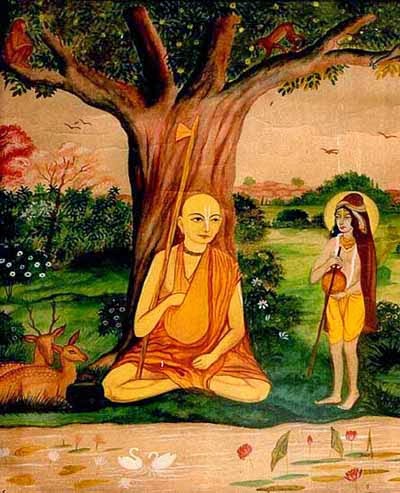
madhavendra puri meditates below tree while cowherd boy gopala brings him milk in disguise

Oh how incredible!

You have a 3D form of the Lord to worship – Hurrah! Hari! Jai! Haribol!

Now you might be wondering about how to install their Lordships!

You can do yourself a great and exciting favour by looking to the installation ceremony instigated by Madhavendra Puri under the direction of Sri Gopala as described in the pastime : Ksiracora “the milk thief”.

Gopal instructs Madhavendra Puri:

“Clean my body then wash it with fresh water and offer nice eatables.”

In our sampradiya we are most mercifully blessed by Lord Gauranga and Sri Nityananda with the sublime sankirtan, chanting of Sri Krishna holy names. We should Chant and chant and chant to worship the lord.

Lord Caitanya’s followers disciplic succession have presented many authorized books discussing His philosophy and pastimes. The incident of Lord Krsna’s appearing before the devotee Madhavendra Puri in the form of a most worshipable stone Deity (arca-murti) was first told to Lord Caitanya by His spiritual master, and as described here Lord Caitanya later related it to His followers The practice of worshiping the Supreme deity form made of stone, wood or metal strictly follows the Vedic Scriptural injunctions; one should not, therefore, consider this to be idol worship.

Since we cannot see Krsna in the material world in His original form, by His mercy He becomes visible to us in the form of a Deity, such as the Deities Gopala, Gopinathaji and Jagannatha. One should not think Krsna to be stone or wood; Krsna is always Krsna, the eternal form of bliss and knowledge, but He appears as stone or metal because we cannot see His original spiritual form. By serving the Deity, one associates with Krsna personally. A devotee should not think “Here is stone Krsna,” for although because Krsna is everything He is also stone, Krsna in the Deity form is not the kind of stone that cannot act; rather He can act as the Supreme Lord, even in His stone form. In the temples of the Krsna consciousness movement, under the direction of His Divine Grace A.C. Bhaktivedanta Swami Prabhupada, the worship of the Deities by dressing, feeding and caring for Them is an important part of devotional service. Our spiritual master has said in this regard, “As you give more service to Krsna, He will even speak to you.” This actually happened to Madhavendra Puri, as described in the following narration.

The story begins in the house of Lord Caitanya’s close associate Advaita Acarya, where Lord Caitanya briefly stopped on His journey to Puri, the holy city of Lord Jagannatha. This is an excerpt from an unpublished book by His Divine Grace entitled Lord Caitanya—His Sannyasa and Sankirtan Movement.)

As long as Lord Caitanya lived in the house of Srila Advaita Prabhu, the duty of cooking was entrusted to Sacimata, Lord Caitanya’s mother, for at this last opportunity she herself wanted to feed Lord Caitanya and His devotees to her heart’s content. Every day the Lord wanted to take leave of His friends and start out for Puri, but every day the devotees requested Him to remain for two or three days more, and the kind Lord could not refuse the request. Thus the functions of honoring mahaprasada, holding discourses on spiritual subjects and performing congregational chanting of the holy name Hari, accompanied by music and dance, smoothly continued at Advaita’s home. Lord Caitanya pleased His mother by accepting, with His numerous devotees, the foodstuffs that she cooked.

One day the Lord requested all His devotees who had assembled there to disperse to their respective homes. He advised them to continue the performance of sankirtana in each and every house. They would again see the Lord in time when they visited Niladri (Puri). Sometimes the Lord might also return to Navadvipa to bathe in the Ganges. Advaitacarya, however, requested the Lord to take with Him four of His associates, namely, Nityananda Gosvami, Pandita Jagadananda, Damodara Pandita and Mukundadatta. The Lord then took leave of His mother by touching her feet and circumambulating her holy person.

The Lord started for Puri, and cries of lamentation were heard from the house of Advaita Prabhu. Crying at separation from Him, the Acarya began to follow the Lord, but the Lord requested him to go back and console His mother and the other devotees. Saying this, the Lord embraced him and went on calmly.

Accompanied by His four abovementioned associates, the Lord proceeded towards Puri via Chatrabhoja. This route stretches from Santipura along the bank of the Ganges to Atisan, Panhatie (Sodepura-agarpara) and Barahanagar (a suburb of Calcutta). In those days the waters of the Ganges flowed by the town of Kali-ghata. The Ganges now flowing by Bhuwanipore and Kali-ghat is therefore known as Adiganga (the original Ganges). This course of the Ganges flowed down via Diamond Harbor by the police station known as Mathurapura. Passing via this Chatrabhoja, the Lord gradually reached the border of Orissa through Briddha-mantreswar.

On His onward march toward Puri through the villages of Bengal and Orissa, the Lord Himself sometimes used to beg alms from the villagers. Customs officers on His way did not disturb Him, and thus He at last reached Remuna, a village about eight miles west of Balasore. Here the temple and Deity of Ksiracora Gopinatha are situated. The Deity Gopinatha is notorious as a thief because He once stole condensed milk for the sake of His beloved devotee. In the transcendental relationship between the Absolute Godhead and His devotees, both the devotees and God Himself take the risk of serving each other at all costs. In transcendence, therefore, notoriousness has the same absolute connotation as eminence.

The story behind Gopinatha’s being notorious as Ksiracora (“the milk thief”) was long before narrated to Lord Caitanya by His spiritual master, Isvara Puri, and the Lord wanted to repeat the story to His followers.

Although Lord Caitanya was the Supreme Godhead, He accepted Isvara Puri as His spiritual master, and by this act He taught us to accept a guru, or spiritual master, in the line of spiritual disciplic succession. Lord Caitanya introduced Himself as belonging to the Brahma-Madhva-sampradaya, or the chain of disciplic succession that descends from Sri Krsna in the following manner. Sri Krsna, the Supreme Personality of Godhead, transmitted transcendental knowledge to Brahma, from Brahma it came down to Narada, and from Narada to Vyasadeva, who is said to have initiated Madhvacarya. From Madhvacarya the disciplic succession descended as follows: (1) Nrhari, (2) Madhava, (3) Aksobhya, (4) Jayatirtha, (5) Jnanasindhu, (6) Dayanidhi, (7) Vidyanidhi, (8) Rajendra, (9) Jayadharma, (10) Purusottama, (11) Brahmanyatirtha, (12) Vyasatirtha, (13) Laksmipati, (14) Madhavendra Puri, (15) Isvara Puri and (16) Lord Caitanya.

Introducing the story of Gopinatha’s stealing some condensed milk for Madhavendra Puri, Lord Caitanya related that Madhavendra Puri always remained in trance and chose to wander alone, unaccompanied by his disciples. When Madhavendra Puri was in Vrndavana, he was once sitting under a tree near Govardhana Hill. He did not have any food, but a young cowherd boy appeared before him with a pot of milk and offered it to him. The cowherd boy inquired why he did not ask for alms, and he also asked what he did in his meditation.madhavendra puri meditates below tree while cowherd boy gopala brings him milk in disguise
The svami, Madhavendra Puri, was very pleased to see the beauty of the cowherd boy, and he forgot all about his hunger and thirst. He asked the boy where he lived and how he knew that he was hungry. The boy replied that he was a resident of Govardhana Hill and that no one in his jurisdiction remained hungry. Some of the village women had seen the svami sitting underneath a tree without food and had conveyed the news to him. Saying this, the boy left without further delay on the plea that he had to milk his cows.

Puri Svami drank the milk left by the cowherd boy and waited in vain for him to return to take back his pot. He sat down under the same tree the whole night, chanting the holy name of Hari (Krsna), and at the end of the night, when he lightly slept, he dreamt that the same boy had come again and taken him by his hand to a place congested with creepers and plants.

The boy explained that he had lived in that hedge for a very long time and was suffering through the winter, summer and rainy seasons without an adequate shelter. He was just waiting for Madhavendra Puri’s arrival, for he intended to expose himself to the eyes of people in general by accepting his loving service.

The arca form of the Absolute Personality of Godhead is identical with Him. The Absolute Godhead is not different from His name, fame, form, pastimes, qualities and entourage. He descends to favor His bona fide devotees and appreciate their transcendental loving service. The name, form, and so on, of the Absolute Godhead, being absolute themselves, cannot be experienced by the material instruments of sense perception, but by the unbounded mercy of the Absolute the transcendental loving service of His devotees makes it possible for one to see Him as He is.
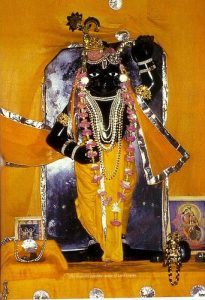
sri nathji madhavendra puri deityThe transcendental cowherd boy agreed to come within the view of the general public in His arca-murti because He was pleased with the loving devotion of Madhavendra Puri. The arca-murti of Godhead is not, therefore, an idol fashioned by an iconographer. The arca-murti is potent and has all the transcendental qualities of the Absolute Godhead, but one can perceive them only through loving service. A material example may help one understand this. The post office authorities establish a mailbox near one’s home, and all letters posted in it reach their respective destinations without difficulty. An imitation mailbox designed to compete with the genuine one will not serve the same purpose; the letters posted in the imitation box will never reach their destinations. The difference between the two boxes is that one is authorized whereas the other is a mere facsimile.

Just as a genuine mailbox is different from an imitation one, so the arca-murti revealed to the general public by a devotee of the caliber of Madhavendra Puri is different from the idols of iconographers. The icons of the idolators are like the statues installed in parks and Squares for the appreciation of the public. These statues serve no other purpose than to provide sitting places for crows; they cannot do anything, no matter how extensive one’s prayers or admiration.

Therefore, the arca-murti of Gopala who out of His own mercy directed Madhavendra Puri to bring Him out into the open must not be mistaken to be an idol, but He must be accepted as the Absolute Godhead Himself.

The next morning, therefore, Puri Svami approached the villagers of Govardhana and asked them to help him extricate the arca-murti of Gopala who was in the dense forest. The villagers gladly followed him and cleared the way for him to enter the place he pointed out. When the tangle of plants and creepers was removed, the weighty figure of Godhead was found. Some of the strongest among the men put their shoulders together and carried the Deity to the top of the hill of Govardhana, where the Deity was set on a big throne of stone and supported by another big stone from behind.

All the villagers were somehow informed of the Deity’s presence, and they came there in large numbers, the brahmanas bringing with them new earthen pots full of strained water from Govinda-kunda (a sacred pond). The water pots were one hundred in number. A festival then ensued, as bands performed and the village women sang songs. Some of the village folk began dancing, and the villagers duly brought forward milk, curd and clarified butter that they had collected for the Deity. Sweetmeats and other foodstuffs of various descriptions, along with numerous presents such as flowers, tulasi plants, new clothing and so on, came in abundance.

Madhavendra Puri personally performed the preliminary function of abhi-seka (a ceremony to sanctify the Deity) by washing His entire body with the water brought in the earthen pots and smearing His body with fragrant oil. After the ablution of the Deity, he properly dressed the Lord’s body and decorated Him with flowers mixed with the paste of sandalwood. Aratrika was then offered to the Deity to welcome and worship Him, and all the foodstuffs brought by the villagers, as well as more food especially prepared for Him, were presented before Gopala.

Ten brahmana cooks were engaged to cook rice and dahl, five brahmanasto prepare vegetables and five to seven brahmanas to bake bread. All the cooked foods were finished by the addition of abundant clarified butter. Then the rice was stacked on the floor upon a new cloth spread out for this purpose, and the bread was exhibited before the Deity in the manner of small hills. The vegetable curries, cakes and other preparations were all brought forward in suitable pots, and fragrant, cold drinking water was also offered in many new earthen pots. In this way the Annakuta ceremony* was again revived by Puri Maharaja, and Gopala, the Absolute Personality of Godhead, who had been hungry for a long time before Madhavendra Puri’s arrival, ate all these transcendental cooked foodstuffs to His heart’s content. Although Gopala ate all the food, leaving not a bit of it, He again restored it all by a transcendental touch of His hand. Only Puri Maharaja perceived this spiritual process, for Gopala was unable to conceal His inconceivable acts from an associate like Madhavendra Puri.

We have already discussed some logical conclusions about the arca-murtiat some length, and now we may also discuss to some extent the offering of foodstuffs to the Deity. The arca-murti accepts only foodstuffs offered by bona fide devotees. The Absolute Godhead is always perfectly full in all respects, but He condescends to accept an offering of flowers, leaves, fruit or water if it is offered in transcendental loving service. If one is not hungry he is reluctant to accept even the most delicious and palatable dishes because in the absence of hunger nothing is pleasing to the taste. But if one is actually hungry he may accept food which is not even palatable. God, however, being full in Himself, is both hungry and satisfied simultaneously. Although He is always satisfied, He becomes hungry when one offers food to Him with a fully devotional attitude of transcendental loving service. He then accepts the food for the sake of His servitor and again replaces it with His transcendental potency to influence the revival of the spiritual senses of everyone who partakes of the remnants of such prasada (spiritualized food). Therefore, there is a gulf of difference between distribution of ordinary foodstuffs and distribution of spiritualized prasada. By accepting and distributing the former, both the giver and the taker become subject to the laws of karma, whereas by accepting and distributing the latter, both the giver and taker transcend the laws of karma. To offer cooked or uncooked foodstuffs to the Deity is to perform yajna(sacrifice) as ordained in the sastras (scriptures), but to cook or collect foodstuffs for one’s own self is to put oneself under the severe laws of nature. By performing yajnas we can have foodstuffs in abundance from the storehouse of nature, but campaigns encouraging farmers to grow more food for our own use simply enrage nature, who then restricts the supply. Such campaigns for self-satisfaction are sure to aggravate scarcity in the world, in spite of all scientific assurances to the contrary. Since the leaders of materialistic nations do not know this secret law of nature, when their materialistic endeavors are baffled at the cost of the lives of many innocent followers, these leaders, not knowing the defects in their foolish acts, escape by saying that nature is unkind.
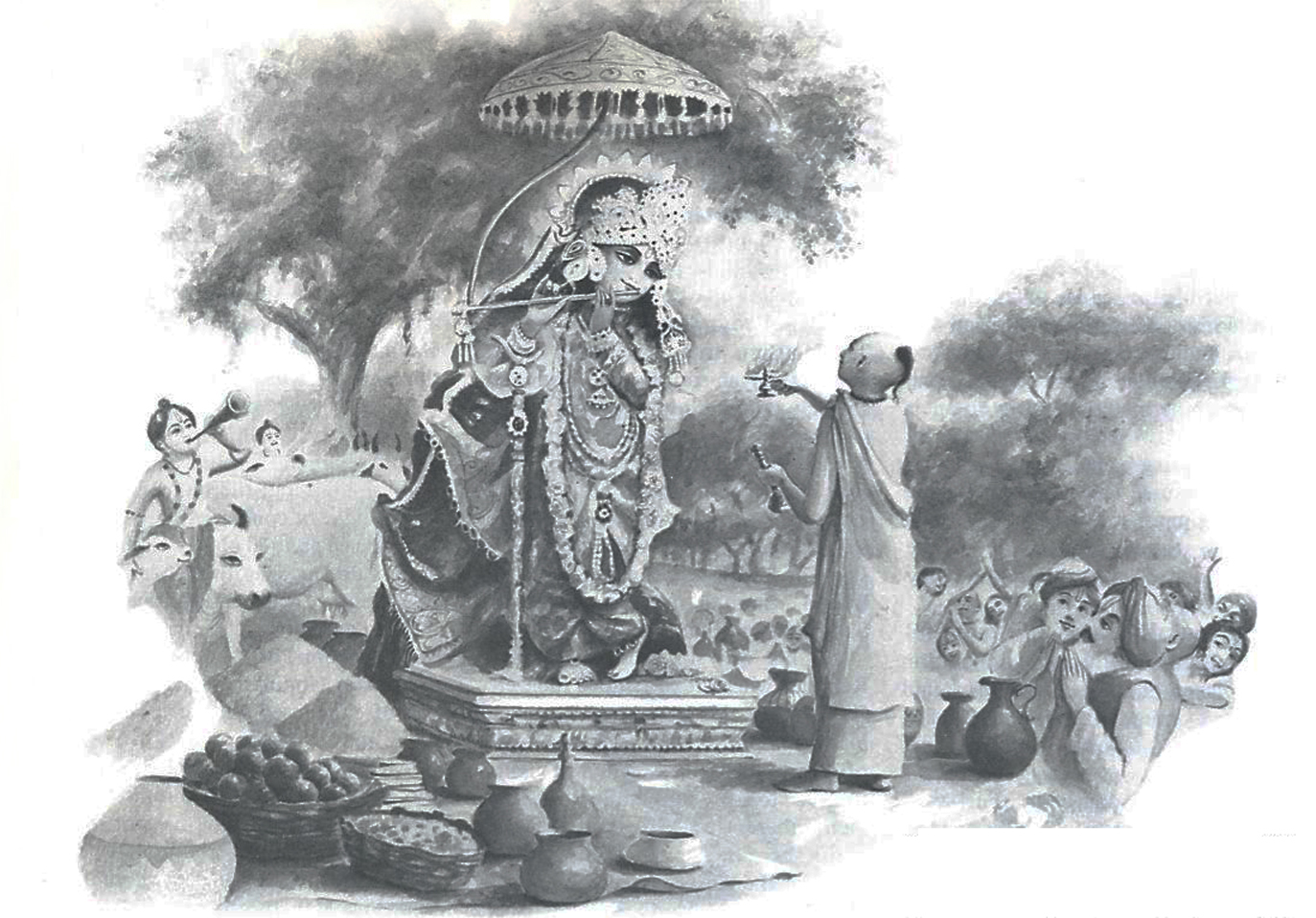
Led by Madhavendra Puri, the villager welcomed and worshiped the Deity. Pleased by devotion, the transcendental cowherd boy agreed to become visible to the public.

Led by Madhavendra Puri, the villager welcomed and worshiped the Deity. Pleased by devotion, the transcendental cowherd boy agreed to become visible to the public.

Following the Vedic process, therefore, the foodstuffs were all offered to the Deity, and by the order of Puri Maharaja the prasada was lavishly distributed to all the villagers, including old men, women and children. First it was offered to the brahmanas and their wives, and then to all others, one after another. The men who came from other villages to see the function were also sumptuously fed, and everyone was astonished to see the influence of Puri Gosvami. Puri Maharaja then turned all the brahmanas into Vaisnavas (devotees) and entrusted them with various duties in the service of the Lord, for it is the function of a bona fide spiritual master not only to engage himself in the Lord’s service but also to engage all others who accept him as their spiritual master.

The entire country was informed of the appearance of Gopala, and thus men from all the neighboring villages came to visit Him. All the different groups of villagers asked to perform the Annakuta ceremony in turn, and thus day after day the villagers brought rice, dahl, wheat products, vegetables, clarified butter, milk, sweetmeats, flowers and various other offerings for the Deity. The brahmanas again and again cooked and offered foodstuffs to Gopala and distributed prasada to all.

Gopala Himself, being the Personality of Godhead, is the natural center of gravity for all people—namely, brahmanas (intellectuals), ksatriyas(administrators), vaisyas (agriculturalists) and sudras (laborers). According to Srimad-Bhagavatam, the brahmanas constitute the face of the Deity, the ksatriyas His arms, the vaisyas His thighs and the sudras His legs. None is less dignified in terms of the transcendental service he offers as a limb of the transcendental body of Gopala. When, however, the brahmanasksatriyasand other occupational communities forget their relationship with the loving service of Gopala, they become degraded. By forgetting the service of Gopala one forgets his constitutional position and is thus deluded by maya (the illusory energy). Covered by such maya, one tries to enjoy material nature on one’s own account, which one cannot do, instead of serving Gopala by the grace of spiritual nature. This causes a struggle for false supremacy among the various classes or castes, bringing about the destruction of everything that they try to enjoy.

The true realization of a peaceful society is possible through cooperation of all classes or castes, centered around the transcendental service of Gopala. The villagers of Govardhana and other neighboring towns, acting under the guidance of Madhavendra Puri with Gopala as the Lord of all, offer an ideal example of how to live in a spiritual society that can bring about real peace and prosperity. In such a society there is direct communion with God, for its members realize that everything is for God and that God is for everyone, irrespective of caste, creed or color. In such a perfect society, Gopala is the center of all.

The holy place of Gopala thus became well known to everyone, and whoever came there offered as much as he could afford. Rich men offered costly clothing and many valuable gold and silver ornaments, and one rich ksatriya who came there built a big temple for Gopala. Some of the villagers constructed boundary walls, and others erected a cooking house. Each one of the inhabitants of Vraja gave one cow to Gopala, and in that way about 10,000 cows were collected for His service. The four occupational orders of society thus contributed their skills for the service of Gopala. Two renounced brahmanas who came from Bengal were carefully provided for at the temple. These two brahmanas, who became disciples of Madhavendra Puri, were entrusted with the daily worship of the Deity.
Posted on 4 Comments

Choosing a Deity for Family life

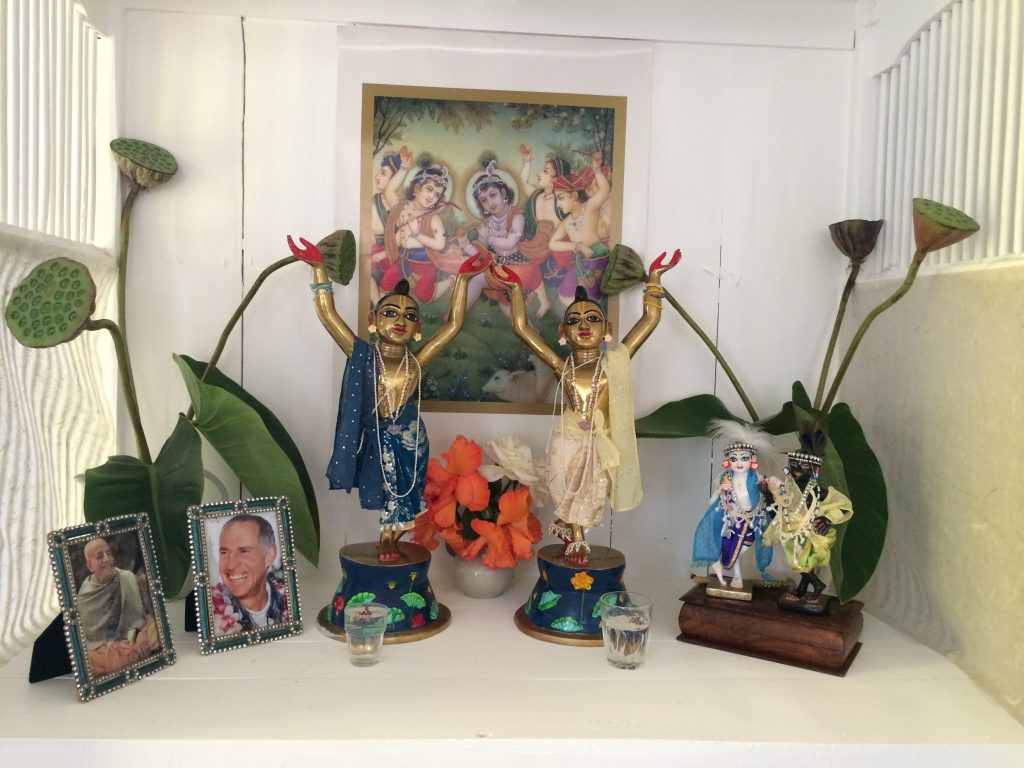
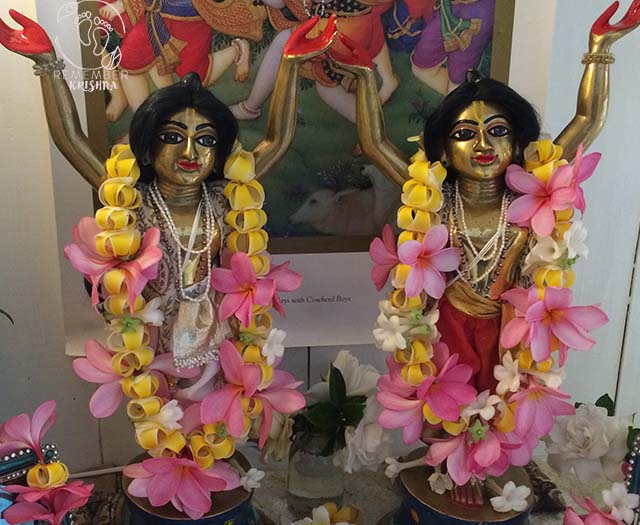
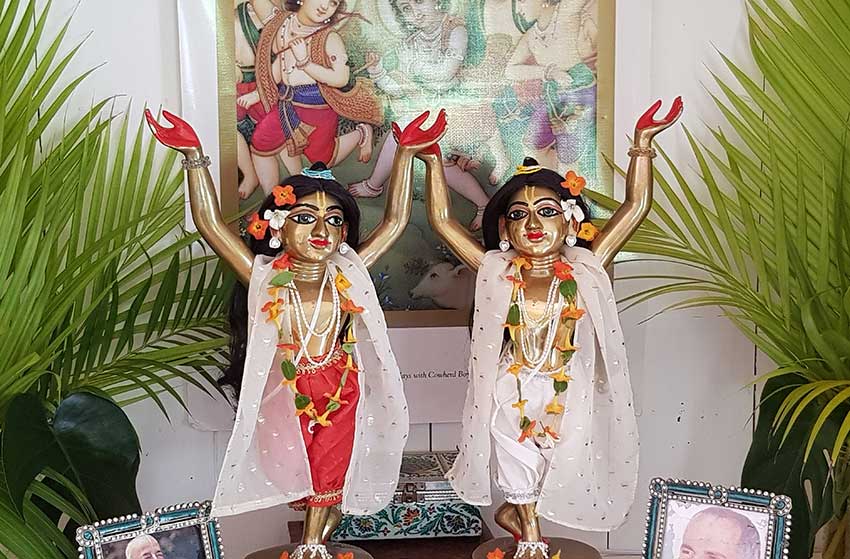
Nitai Gaur deities sita's lords raised arms chanting and dancing deities beautifully dressed and decorated with flowers and wigs

Firstly you may already have a preference, for metal, marble, wood or resin.

I would like to acknowledge first off that for the point of clarity I will be calling them metal/wood/etc deities but the material element never defines the Lord! Please in general practice do not refer to the deity as a “metal Krishna” etc, as this is both not respectful nor accurate. As soon as the Lord accepts your worship in the form then that form immediately becomes transcendental.

This article is to help you select the most practical form for worship in your particular household situation, and will draw on my experience in painting, caring for and worshiping a variety of deities.

  • Who will be caring for the Lord?
  • Will you be transporting the Lord frequently?
  • Is size a consideration?
  • Are you/your family members more drawn to certain materials?

Before you start, ask yourself this:

Do you have small children?

Are you planning to have small children assist with caring for the deity?

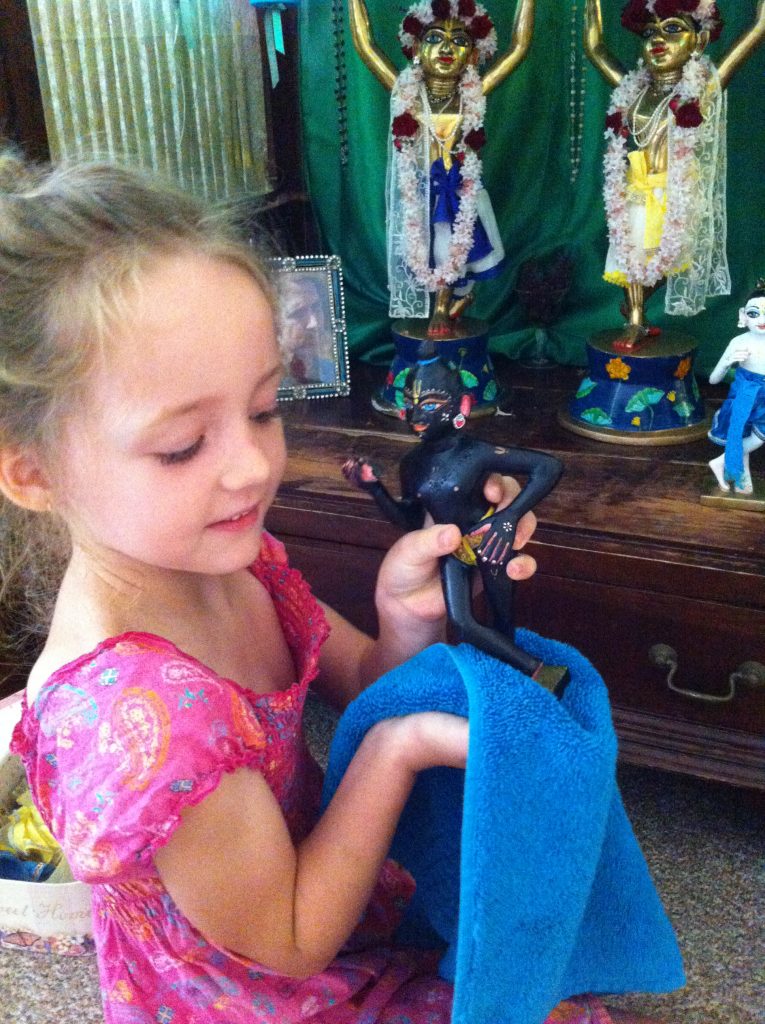
home deity worship child cares for bathing of krishna deity

In our home, my daughter received Krishna & Balaram at age 4, and we chose metal Krishna and Balaram forms, two beautiful cowherd boys, with practical selection of metal so that they could withstand if they were accidentally knocked or tipped over, and able to be bathed and dressed as desired.

The practicalities of having deity worship with children should be considered – will your children jostle and fight over who gets to assist, and potentially knock the deity, or are they very well trained and respectful, or older?

In most instances I would suggest that families who want to involve children in deity worship should select forms of a mixed metal substance. Such forms are not easily damaged, moved, jostled etc, and while we train our kids to be respectful, unfortunately in enthusiasm or an excess of excitement little accidents can occur.

If you don’t want your heart to leap into your throat everytime your child or children approach the deity I heartily recommend you select a metal form.

Easy to buy ready to wear deity jewellery
Gaur Nitai with beautiful simple pearls – bought as a simple strand and tied. no DIY required.

With great joy we have the delight of serving Nitai Gaur deities whose forms are mixed metal, with lovely large solid bases, and a size of 21″ (4 inches of which is their large circular base). Our deities have been cared for lovingly by children since baby age, and have never once been knocked or fallen over or sustained any other sort of indignity which could potentially occur with smaller deities or less stable deities.

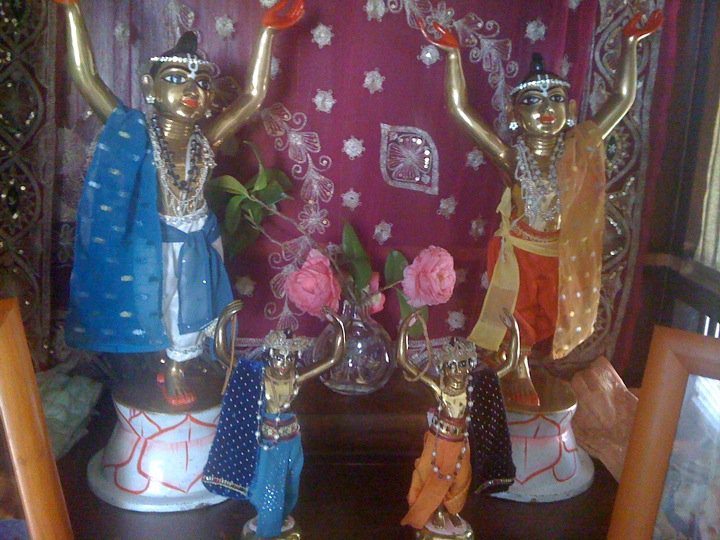
nitai gaur deities in two sizes, small gaura nitai large nitai gaur deities both beautiful
You can see my 21″ deities and mums 7″ deities

My dear mother has charmingly delicate and petite metal deities of Gaur Nitai, and while they are robustly metal in form, they are more precarious and difficult to take care of, because of their smaller size and less stability. Her deities are approx 7 inches tall and so adorable!

https://www.instagram.com/p/BjqTzV9g5RZ/?utm_source=ig_web_copy_link

Growing up with her beautiful Lords – their small size and bases meant that she was quite protective, and until we were over 10, we were assistants at the dressing of the Lords only, allowed to put on a necklace here or there, or pour their bath water, but in dressing they are more vulnerable to tipping.

It worked in our family – instead of dressing the Lords, we all got the chance to offer arotik & be the pujari, or to read the story and sometimes lead some kirtan.

As a side note – it’s easier to make clothes for larger forms!

Is Size a consideration?

There are advantages and drawbacks to small and large forms, and you must weigh each one careful and consider what best works for your situation.

When you are weighing the advantages vs the disadvantages you may consider the following:

SMALL Forms

  • more transportable, lightweight for the weak
  • harder to see from a distance or close when your eyes get bad!
  • less fabric to dress, but much more fiddly to sew for
  • smaller deities = smaller altar

Large forms

  • stable not easy to knock over
  • heavier to transport, or lift
  • easy to feast your old eyes on and see from distances
  • costlier to dress in fabric and braid and trims
  • easier to sew for
  • larger deities = larger altar

You can find small and delicate metal moorti of both Nitai Gaur, Krishna, with varying degrees of refinement

Do you intend to travel with your deity or deities?

This is particularly important in the selection of your murti form.

Whether you have Nitai Gaura deities, Krishna deity, Radha Krishna deity or a deity of some other form of the lord, I encourage you to consider whether you will attempt to bring your deity with you if travelling.

There are many different sized forms available, and if you are travelling then I would encourage you still, that metal is very durable, although heavier. Wood could get caught up in customs! Plaster or resin is more fragile, and marble is the most fragile!

I currently have in my care a particularly fine pair of metal Radha and Krishna murtis (at approximately 6 inches tall) who would be extremely easy to carry travelling *side note!

Travel with Lords in hand luggage.

You would not want to lose them should any luggage go astray!

https://www.instagram.com/p/B1k_vpkAwqQ/?utm_source=ig_web_copy_link
Travelling with Krishna

In preaching work, this beautiful dark Syamasundar Krishna is always travelling. He has a lovely travelling case! It is a converted make up box. It’s gold, which is fitting! We lined it beautifully with fabric and it contains some essential outfits and accessories, and He travels first class by air 🙂

Ashadhatu weight can be an advantage – making the statues very stable.

You have the option to select ashadhatu forms which are a mix of 7 or more metals, including lead and traditionally these deities are much heavier than the other forms of metal based statue available.

Do you need Ashadhatu deities? NO! Gosh no. While it is very nice to have them, as they are created carefully and lovingly – it is unnecessary. The Lord can accept whatever deity form He desires. I would liken it to offering Him ceramic or brass bowls to eat from… or ruby studded. There is no problem, but it is not a requirement. Offer with love and He will accept with great love and affection.

Some years ago, a sweet friend of mine allowed me to help her with selecting and ordering (Ashatdhatu) Gaura Nitai statues for her home worship. She also received Krishna/Balaram forms. Having two rambunctious young boys (toddlers at the time), she wisely chose to have metal forms of the Lord and is now comfortably able to allow her enthusiastic helpers to assist with caring for their Lordships.

Marble statues are fragile first

Conversely it has been to my dismay that friends with marble forms have had incidents where simply a table has been bumped, and the statue has fallen over and broken. Oh the heartache! With the best intentions in the world, this can happen.

https://www.instagram.com/tv/B2dL3EFATIy/?utm_source=ig_web_copy_link

My own sister had a first Marble form of Krishna ready to install and worship, and in the very first week of receiving the statue, prior to installation, the form was standing on a table which was bumped, and the form fell and broke!! Only imagine!

She persevered, and ordered another Krishna statue carved which is now sacrosanct and NO ONE but her is allowed to come near Him, touch Him or handle Him.

I have Him visiting our home right now! (ok she made an exception for me) but I cannot allow my daughter to assist even with placing His flute because my heart trembles everytime anyone else approaches. I nearly died of a heart attack last night when my daughter told me she was moving the altar and rearranging the living room (gasp!) That was promptly stopped!

If you are interested in seeing him, here’s a sneak peek at His charmingness as He graces our home…

Radha’s Krishna visits Sita’s home!

For guidance on how to care for Krishna deities once you have invited Him to your home I would like to suggest you view this excellent series of videos from lovely qualified Vaishnava devotee of Krishna who has much more spiritual understanding and authority than myself.

If there are any mistakes or inconsistencies or incorrect conclusions in my blog post, I humbly request that you overlook them, and be assured that my intention in writing this article is only to offer helpful advice in the practicalities of selecting a form to worship in your home.

From my heart,

Sita dasi

Posted on Leave a comment

Krishna, My Valentine

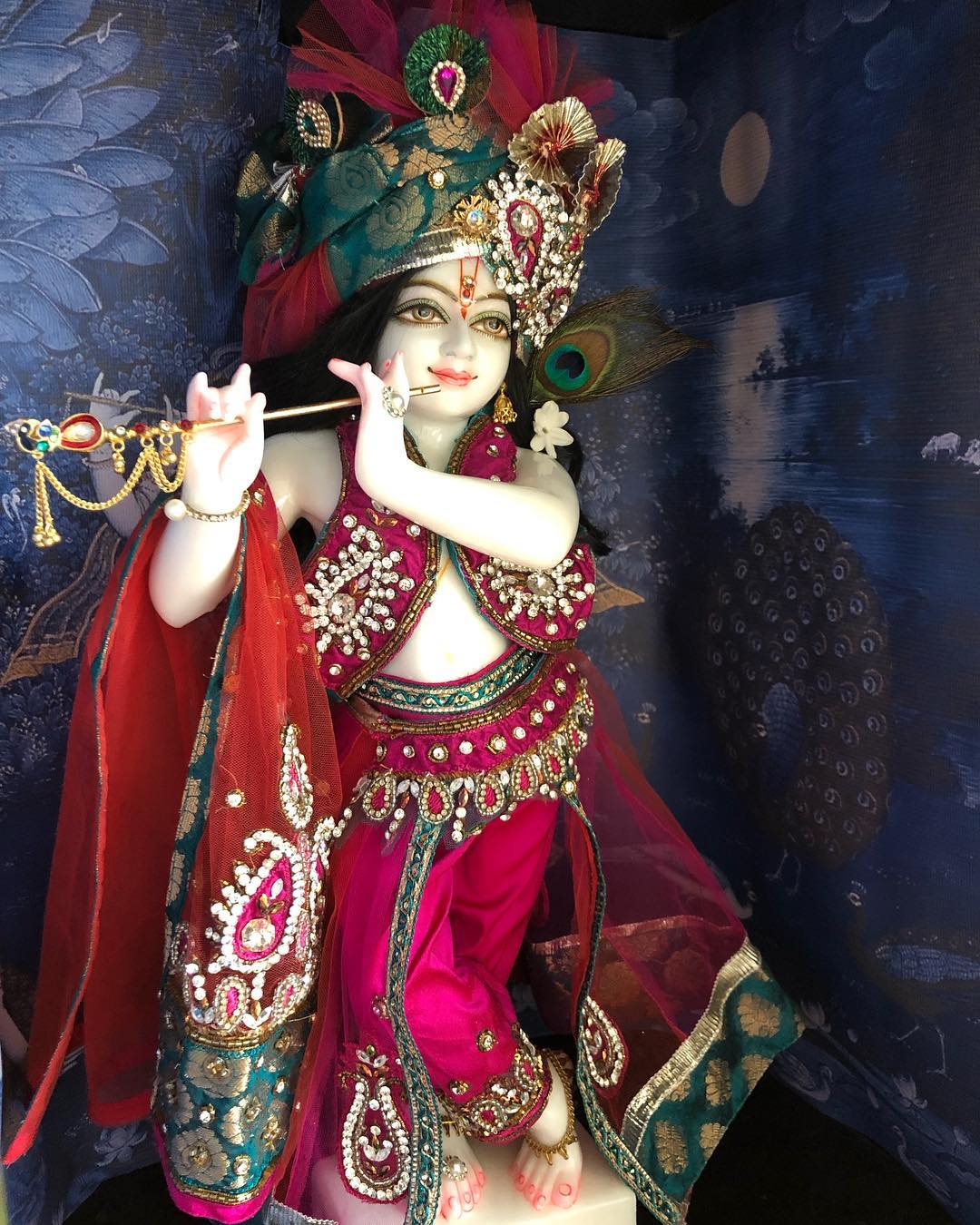
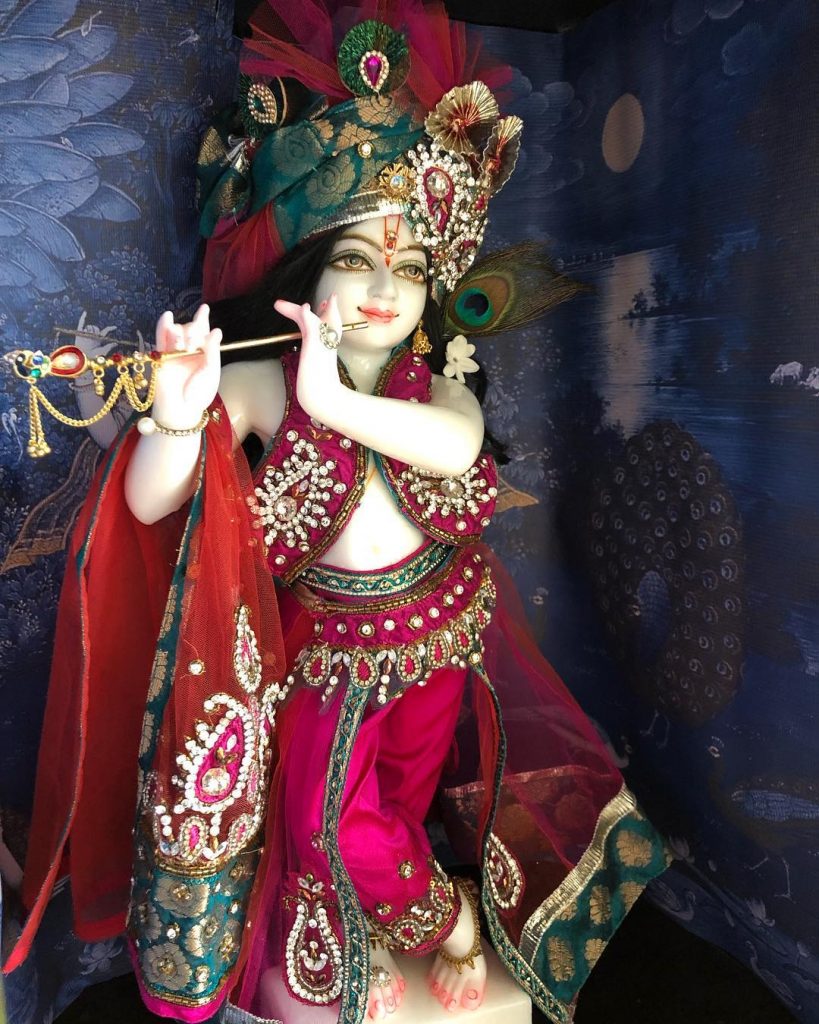
Krishna deity stands with beautiful three fold bending form holding flute dressed in fuschia pink and turquoise outfit with skirt, vest and shawl
https://www.instagram.com/p/Btg960ag1tD/?utm_source=ig_web_copy_link

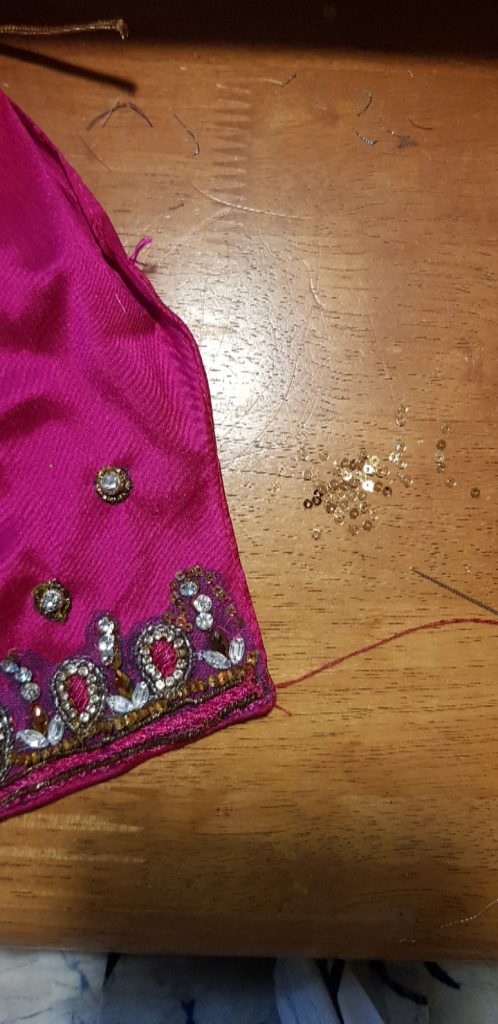
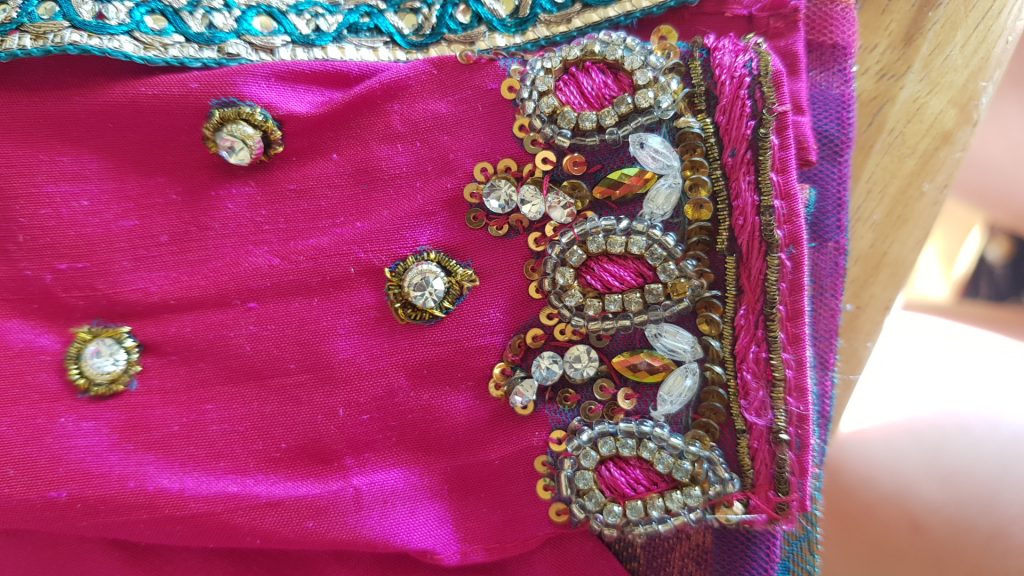
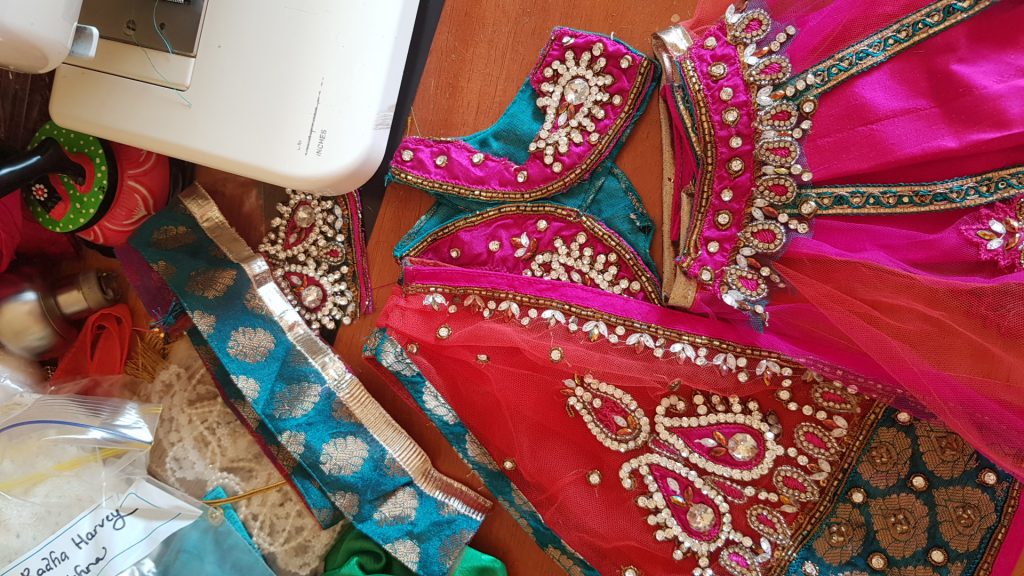
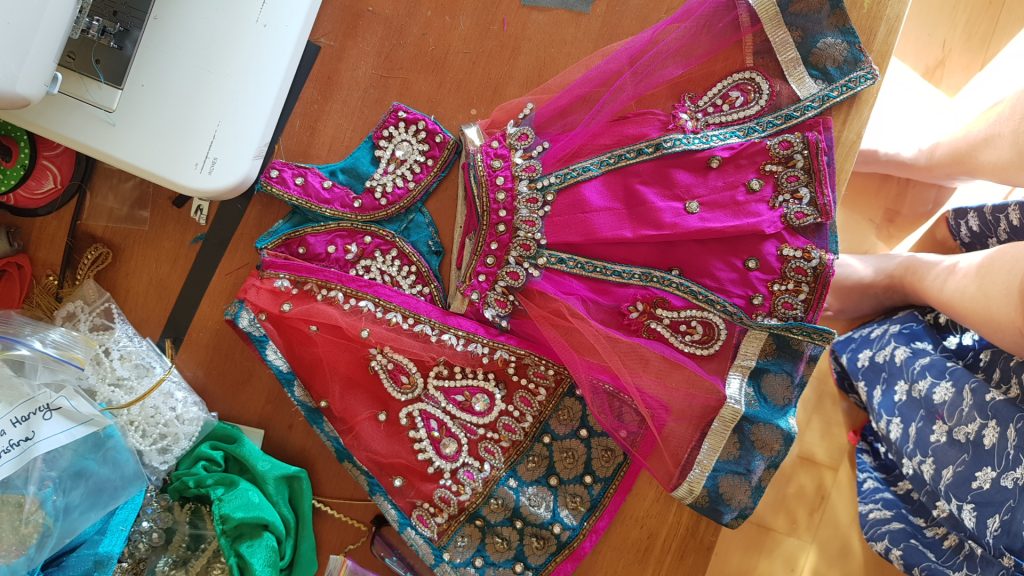
We had found and bought this gorgeous little girls dress with the specific intention of dismantling it and reconstructing as an outfit for KRISHNA!

My sister Radha dasi worships this most exquisite Krishna, and it is my pleasure to be Krishna’s personal tailor. So Radha & Sita adventures in dressing Krishna commence with such fun ambition!

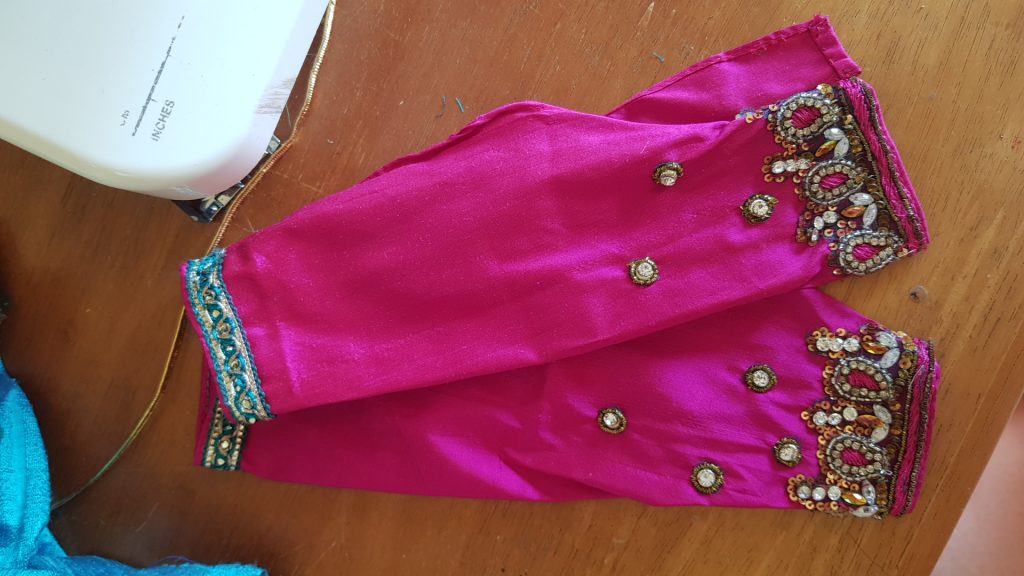
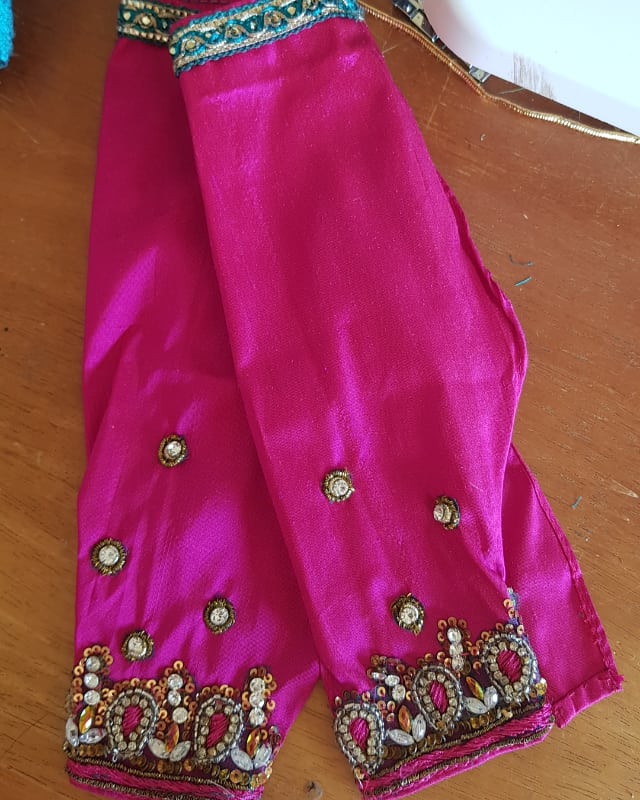
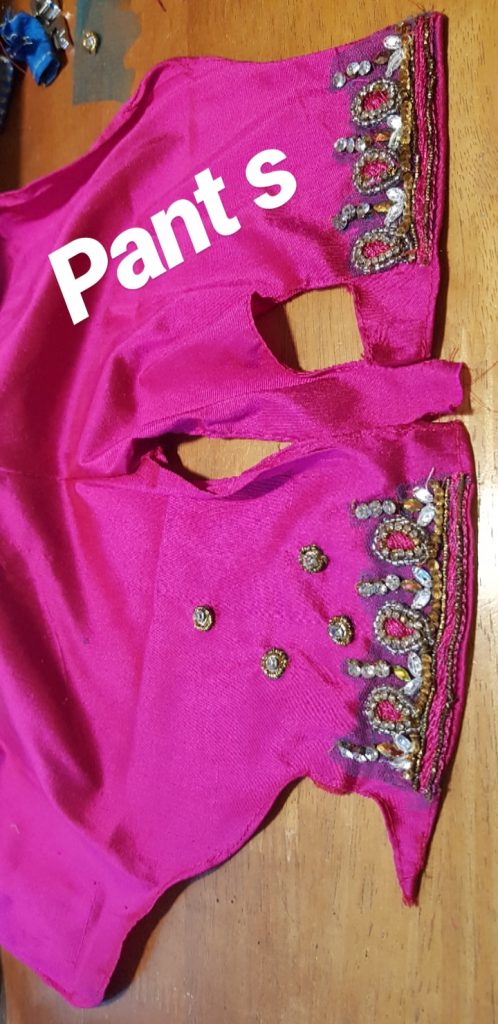
Using a lightweight shantung silk of a nearly perfect matching color (it took close to an hour to decide from my fabric silks which match was the best of 3!) I made pants.

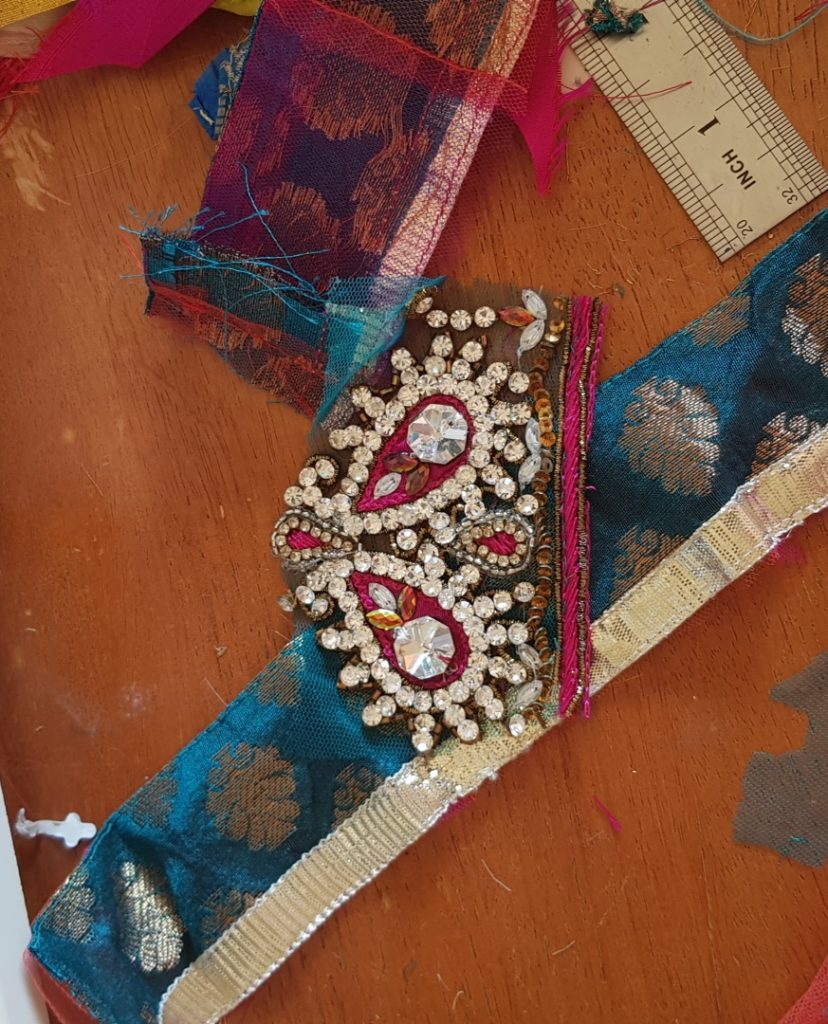
The pants I added on the beautiful decorations and fresh gold sequins.

The little cap sleeves of the dress made perfect vest! You can see it in the pictures.

Using the net overskirt, I made a shawl and also the overskirt for Krsna – adding on extra embelishments and a special piece at the waist.

The outfit was looking beautiful! I was going to end it there! and I shared pictures with Radha and she said… what about a turban. HAHAH

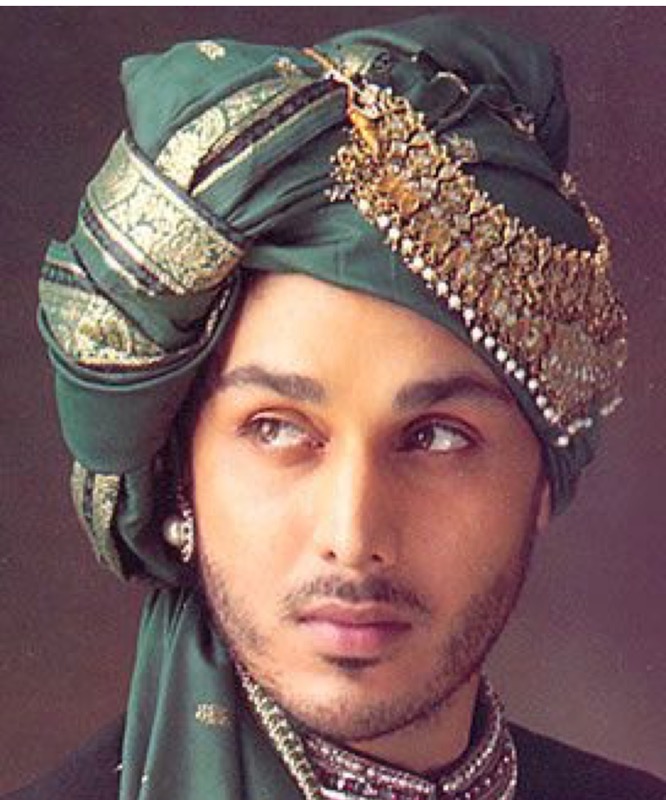
Well she sent some inspiration – this princely picture of a turban, and it is what I was hugely inspired by.

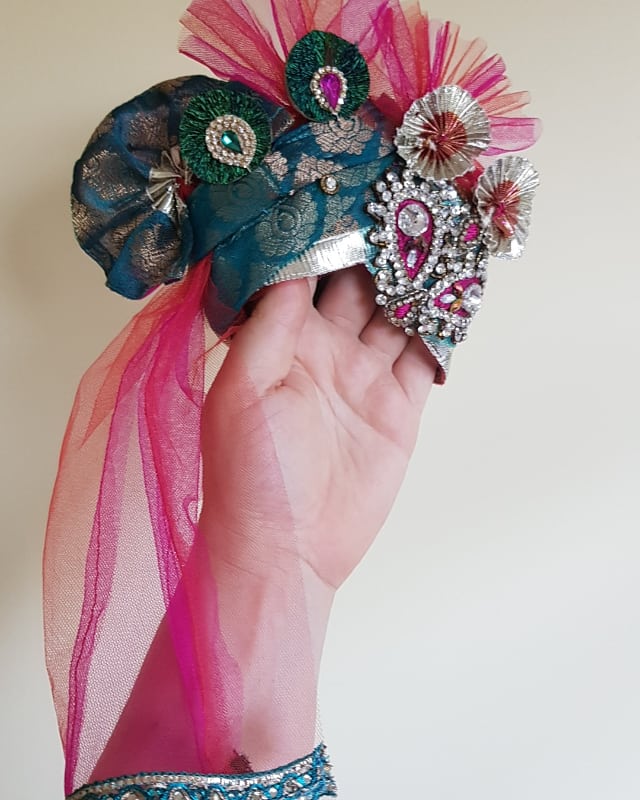
Taking cue from this picture, I decided on a side mount of the remaining pieces of bling! I also used some more net, to do an extended long turban section, inspired by the above. Net fans and braid fans as well as some gorgeous accessories from India of peacock and fuschia jewels with peacock feathers were inserted.

I haven’t set up any pant tutorials for you yet, but when I do, and when I have the turban tutorial, I will update this post with links for you.

Krishna deity stands with beautiful three fold bending form holding flute dressed in fuschia pink and turquoise outfit with skirt, vest and shawl

In the meantime, enjoy admiring sweet Sri Krishna in His Valentines day outfit!

https://www.instagram.com/p/BuMuzHcAZOm/?utm_source=ig_web_copy_link
Posted on

Sewing for Sweet Krishna

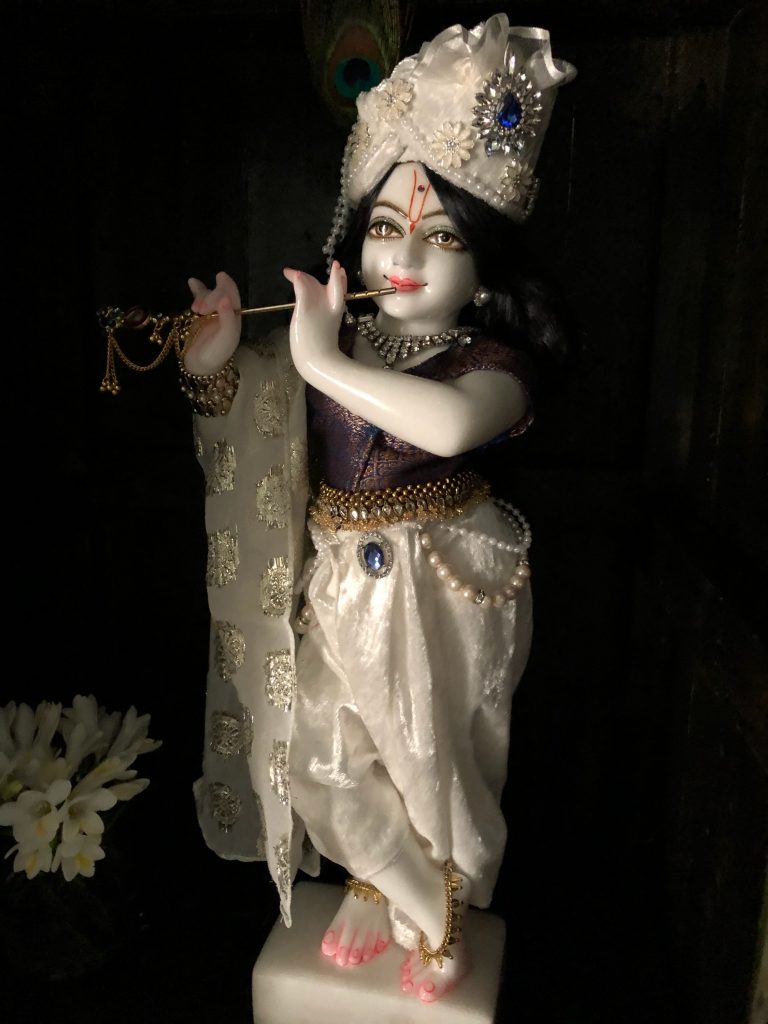
krishnas temple wearing green and white velvet

There were a number of things that made this time wonderfully exciting for me, and I have SO MANY pictures I feel I could do at least 6 blog posts to cover them all! Only- I don’t think I will, so I might just tell you all about how KRISHNA CAME- CONQUERED – LEFT!

He first arrived to visit in January 2018, and due to a series of unexpected events (all of exciting nature – like, the Hawaiian floods, then volcanoes, then unexpected disappearances in the family, and great moves across the continent!) He ended up staying with me for 8 glorious months of dedicated sewing time, having Him RIGHT HERE for fittings, sitting at my table and available to be closely measured and doted on.

Instagram was full of my different WIP clothes for Krishna, and every weekend was a speed sewing fest. I think I’ve been too busy to focus on anything else! Actually, I lured my sister into leaving Krishna with me, when she dashed home in March, by promising 10 complete outfits with turbans, and not to do anything else until they were done! It was tricky, I had a few distractions, but I MADE IT! 10 beautiful outfits for Krsna, in 3 weeks. Ok maybe more like in 8 months, but by now I have capped the Krishna wardrobe collection, running on to more like… 16? I have to count!


We had a lot of fun naming the outfits creatively!
This is His outfit list:

Lotus (definately one of the favorite outfits!)

Mango Lion;

this one was made thinking about Lord Nrsringadev, with more of a shako style turban for Krishna. It’s an interesting and functional outfit where you can remove that floaty orange silk overskirt, and style it more simply with just the vest, pants and shawl.

https://www.instagram.com/p/BiImERzACv4/?utm_source=ig_web_copy_link
MANGO LION OUTFIT

Purple Majesty

This outfit, such a hit! The purple is one of her favorite colors, and purple and gold = sensational. The Blue and the Purple are almost the same in style, with the puffy pant and the overskirt, top, topped with big turban.

They’re both super majestic and formal and a bit dancey.

https://www.instagram.com/p/Bh2N12bA6tg/?utm_source=ig_web_copy_link
Purple Majesty

Turquoise Lake – this first blue one is the Turquoise lake… it has a matching blue overskirt too.

https://www.instagram.com/p/BitEy1HAFxz/?utm_source=ig_web_copy_link

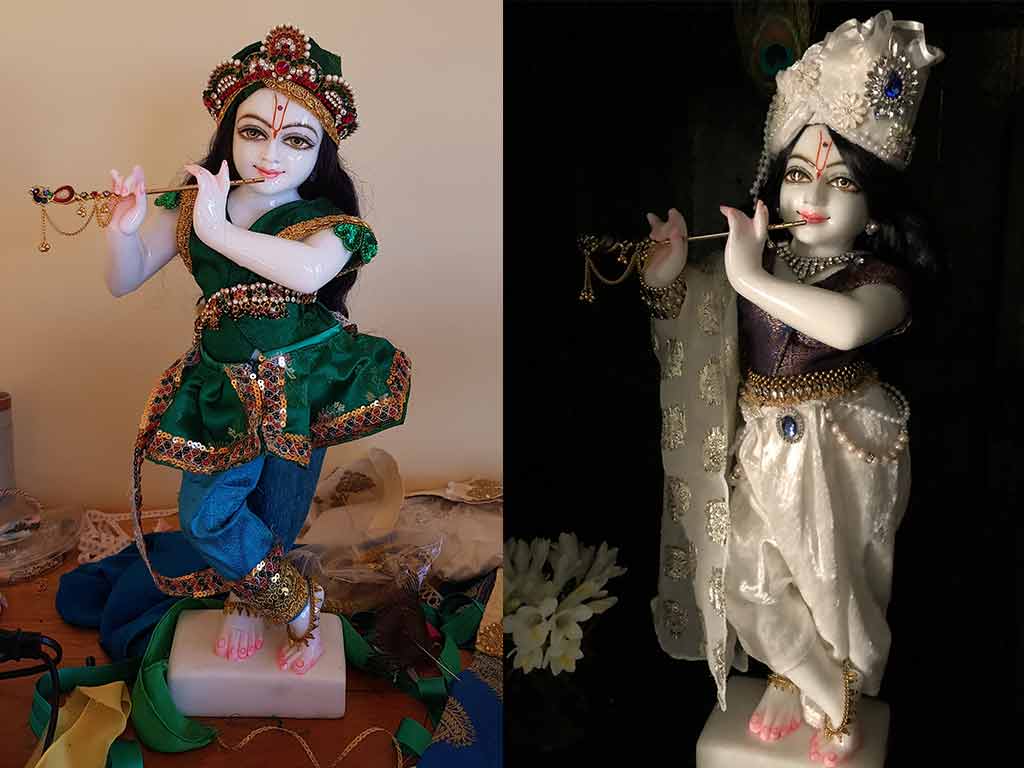
Green & White freshness

One of my earlier efforts, before I went all out lavish after a bit more direction from my sister toward “mathura prince Krishna style”.

It’s still got that glorious dhoti, and the nice useful vest which will probably be great in the changing seasons weather, like the Autumn coolness or unpredictability of Spring.

https://www.instagram.com/p/BhSJaiXjha6/?utm_source=ig_web_copy_link
GREEN AND WHITE OUTFIT

Majestic Prince (the turban for this outfit is my sisters favorite turban – it’s also the biggest and most full on ornamented!)

Honestly I struggled a LOT with this outfit! I made the maroon velvet top, which I think veers towards luscious velvet bathrobe. And pairing it with YELLOW was such a hard choice but it’s so INDIAN I think, and super authentic. The Turban just kept getting bigger and bigger! Still, it’s one of my sisters favorites, she confided.

https://www.instagram.com/p/BiquLULATfT/?utm_source=ig_web_copy_link
This outfit is called MAJESTIC PRINCE

Rose Red

Gasp! Stunning.

Royal Red coat and oriental dhoti

so cute, this coat is made from heavy braid, and topped with a soft silk shirt and a fair bit of braid.
The braid was donated by MadyaLila from Ashraya! It’s the extra’s for one of her Ashraya outfits, so as she told me delightfully, she’s so happy to be twinning with Krishna!

https://www.instagram.com/p/BhplEgogxJX/?utm_source=ig_web_copy_link
ROYAL RED COAT
https://www.instagram.com/p/Bee0kv9DKkx/?utm_source=ig_web_copy_link
Royal Red IN PROGRESS

Bathing outfit – Krishna’s swimming gear, named so because it’s simplicity and pastel colors

https://www.instagram.com/p/BhiaCAzgkI7/?utm_source=ig_web_copy_link
BATHING OUTFIT
https://www.instagram.com/p/Bhh6abQA6rD/?utm_source=ig_web_copy_link
BATHING OUTFIT

Royal Blue – can’t find a photo, but it’s a vest and royal blue dhoti. I’ll try and add a picture later!

Emerald – the most incredible dhoti with reams of expensive gold braid, decorated in pearls!

Now he has hair though, the crown doesn’t fit. The simplicity of this is just to my taste!

https://www.instagram.com/p/BgLGu_1HKdo/?utm_source=ig_web_copy_link
EMERALD OUTFIT
https://www.instagram.com/p/BiGgNeDAY8g/?utm_source=ig_web_copy_link

Balaram Lustre

Balaram Lustre outfit started out with this pristine white velvet, and the concept of a rolled side turban with that higher on one side Rajput Princely style element. It came out REALLY NICELY, I felt, but I did warm up all the white with some blue vest.

I’m particularly keen on the pearl drop elements at His beautiful waist.

https://www.instagram.com/p/BkKt6A9gxG3/?utm_source=ig_web_copy_link
BALARAM LUSTRE

Peacock Outfit

This beautiful outfit has the best set of pants, they’re the final product after 4 attempts at pants, I think I finally made the best type for Him.

They are made from a blue shantung silk, and the outfit has a matching oriental green skirt, with a green silk fitted top. I have also paired it with a high waist belt, as you sometimes see in ancient Indian paintings and sculptures. LOVE IT!

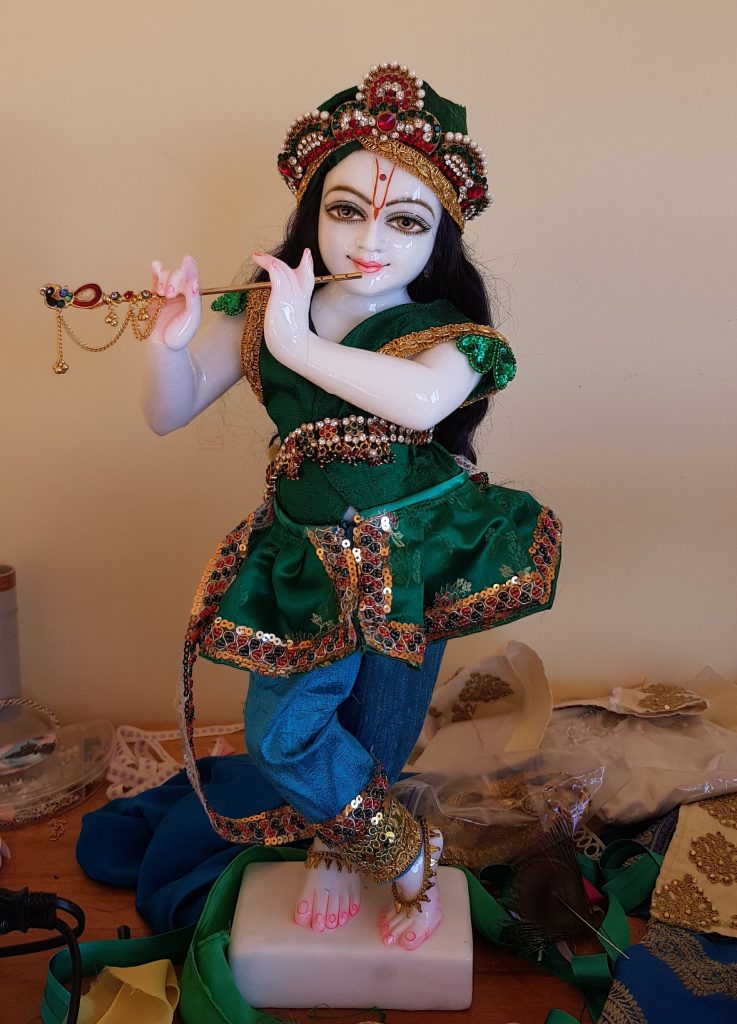
Forest prince Peacock outfit - shantung blue silk pants for Krishna deity, Green oriental silk overskirt, ornate braidwork and forest green shantung silk vest. Krishna deity wears a crown of opulent red green and pearl gems.

Fresh forest flowers – this one is a rejected outfit… I made it, I like it, but it’s not been popular due to the large flowery print, and so it’s one I’m keeping here to model off SIZES. To me it’s very Rajput. And I love it.

https://www.instagram.com/p/BkhuEyQA18m/?utm_source=ig_web_copy_link

Love, Sita

Posted on 2 Comments

Deity Worship – caring for Krishna

Nitai Gaur deities sita's lords raised arms chanting and dancing deities beautifully dressed and decorated with flowers and wigs

Looking after the Lord is pretty sublime. What nicer activity is there than caring for Krishna?

In this day and age there are no hard and fast rules that you need to follow to look after deities of Nitai Gaura or Krishna.

While the nectar of devotion does outline offenses against deities because we have become so far from able to observe all the specific ins and outs it is better for home deity worship to instead understand very practical considerations.

The rules and regulations if you look at them objectively are all there to guide us into nicely caring for the deities, as we would a guest whom was most valued.

If you keep that in mind, then it is very simple to provide the same intention of worship for Krishna and Gaura Nitai. Then even if we are not perfectly correct we are still sincerely trying to be pleasing by establishing a relationship of love.

A lot of times my friends ask in desperation how to look after deities! Especially now, when I do a lot of instagram posts about deity clothes, deity painting, and so on. By no means am I an authority, so all I can share is what I learnt from my dear mother in growing up in how she cared for her deities and so I am happy to offer at least that example, as well as my own understanding on the WHY, that might help inform your decisions when you are not exactly sure what is the pleasing choice.

The most important I would suggest is keeping your practice regular, so that the Lord knows when he is going to eat, bathe, dress, sleep.

You do not have to institute a temple like regime at home, but you should daily visit Krsna and offer Him something, or what is the point of inviting Him to inhabit this archa vigraha form and accept your worship?

The wonderful reason that we are trained in deity worship and adopt it is because it gives us the opportunity to develop a very real loving and caring relationship with the Lord. Whether it is Nitai Gaura or Gopal Krishna the intention is the same. Learn to serve with love*.

There are no hard and fast rules – but you may, depending on the type of deity you have, wish to offer the Lord baths, fresh clothes, & a bed to rest in, along with food, flowers, water or arotik.

To give a practical example, this is my regime of caring for my Nitai Gaura, and my role model is my mother, who has very wonderfully cared for her beloved Gaura Nitai for the past decades. I remember their installation when I was a child as the most incredible event! It was amazing to me and I still vividly remember the sounds, textures, sights – Beautiful deities standing in glowing red translucent bowls being poured over with ghee, rosewater, and the one which really astonished me was yoghurt… more later on what you can do to install your deities.

My deity worship practices:

I bathe before I visit my lords, and ring a bell to alert them that I am coming to see them. I open the altar doors pay my respects and request that they please arise and take their bath.

With prepared warm water in a jug scented with drop of rosewater, I ask them to step into their big bath, “Please step into your bath now my dear Lord Chaitanya”,  and undress them. Pouring the water nicely over the body of the Lord I then take a nice cloth and dry them, “Please step out of your bath now my dear Lord”, before dressing them again for the day.

Once dressed I used to show them their own beautiful reflection in a mirror but it broke and I haven’t replaced it yet…

Then we offer food and have a kirtan with arotik & gurupuja.

I leave lights on for them in the evening and offer them dinner with more kirtan, and then before I go to sleep I invite them to take their rest (usually I say, “please take your rest now my dear Lord Chaitanya/ Nityananda) lay them down (physically placing them in beds) after removing their ornaments and dressed only in the dhoti from the day, cover them with their blankets and lights off.

My mother also reads them a passage from scripture for their pleasure once her Lords are resting and before the lights go out. Such a nice practice!

It’s nicer to have specific pajamas! And dress them in that… I used to completely undress them to put them to bed (it’s very hot here in Australia, and they use only a sheet in summer and a sheet and light blanket in winter) but then I was concerned that they would become cold while waiting for their bath (They stand up out of bed first and I put the beds away to allow room for the bath).

I do not have a specific time which I wake them up or put them to rest or offer dinner, it flows with our family life, but usually I wake them up at 6am and then in bed between 9-11pm. The breakfast offering is before 8am because after that we are getting ready for school. Sometimes I will simply offer fruit, sometimes make it special.

Now it doesn’t have to be this full on, or it could be more so! Some people change their deities garments monthly, or only on appearance days, or every weekend. Some people are far more elaborate than I am! They might be very practiced at having exact times to attend the deities, but in our family we do what we can, and what we can do is care for Krsna like another of the family members, so we do our best and pray that it will be enough.

Marble deities are very fragile, and usually one will not move them about on the altar. Instead of actually laying them down to rest, one can prepare a bed for them, and invite them to take their rest upon the bed. (not physically placing them into the bed).

The most important aspect of worshiping deities of Krishna and Nitai Gaur is to remember that what they appreciate the most, what we can offer them, is the Holy Name. Having an altar there and plonking food down and paying obeisances and moving away… it’s good that you are offering your food but what Krsna enjoys is hearing His names! So better to streamline your deity care, and offer more kirtan with love.

This is my humble attempt to share my practice with you, and offer some practical advice on daily application of deity worship. Please remember it is a relationship between you and Krishna – offer with love and don’t stress out.

Things that we can do to be considerate:

Wash our body before visiting the lord.

Wash our hands before touching the lord or His paraphernalia (his arotik tray, clothes, food, etc)

Be attentive to the Lord while the altar is open or uncovered (don’t conduct other conversations, ignore him, subject the deity to anything unpleasant like nasty noise(Screaming kids!) or fighting.. etc Sometimes it is necessary to pause and gently guide your children before the Lord, don’t freak out it happens when you are raising kids, all the more reason to give your guidance in the most appropriate way with the well-being of your kids in mind).

Offer the lord only vegetarian food (duh, sorry, I just put it in because you know… just in case).

When offering the Lord water to bathe in – give Him fresh clean water that you haven’t put your hands in – the water should be nice and fresh. I get the tap water to the right temperature on my wrist before filling a jug.

Give the Lord a nice sitting place (put some effort into decorating the room of the Lord – this one is fun! You will do this naturally anyway)

Give the Lord a nice resting place (that bed for night time?)

Offer the Lord various refreshments thoughtfully

Offer kirtan for His pleasure..offer Him His own Holy Names with love!

*Don’t worry-  Krishna will help guide you from within your heart, and externally so you may refine your deity worship and offerings… sometimes (ok often) when I am preparing a little offering to my Lord I get the inspiration.. oh it would be nicer if you also offered…

We can get inspired by visiting other nice devotees and see what they do to worship their Lordships too! I know there is just SO MUCH MORE that can be done, but if like me you are in family raising stage of life you probably need to keep things simple, or just need some inspiration to get started.

I hope that my humble thoughts on this will not offend the more learned, and if I am mistaken then please feel free to correct me.

Love,

Sita