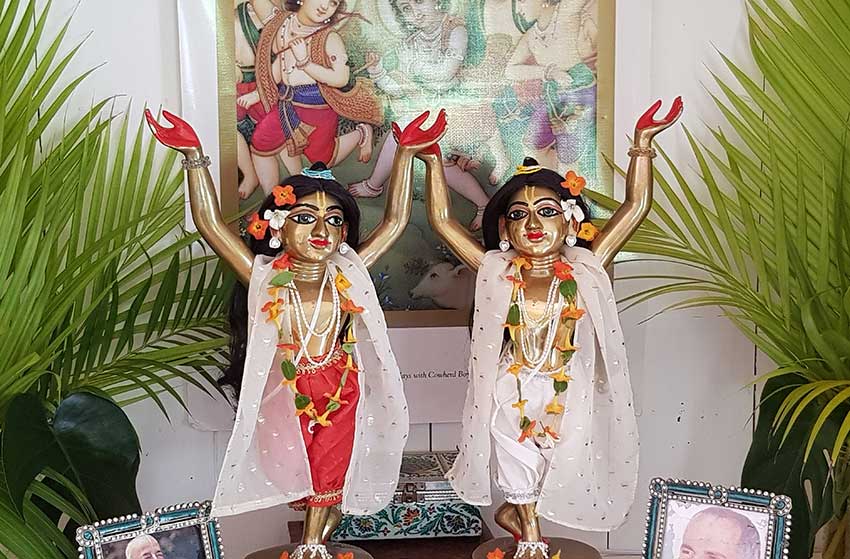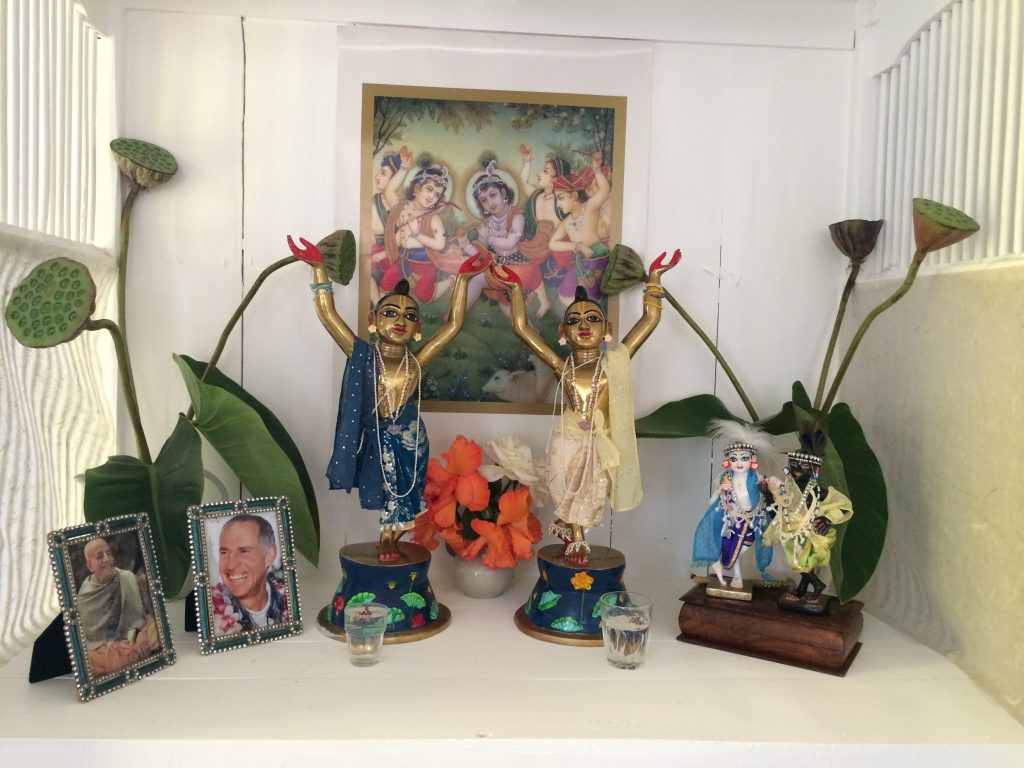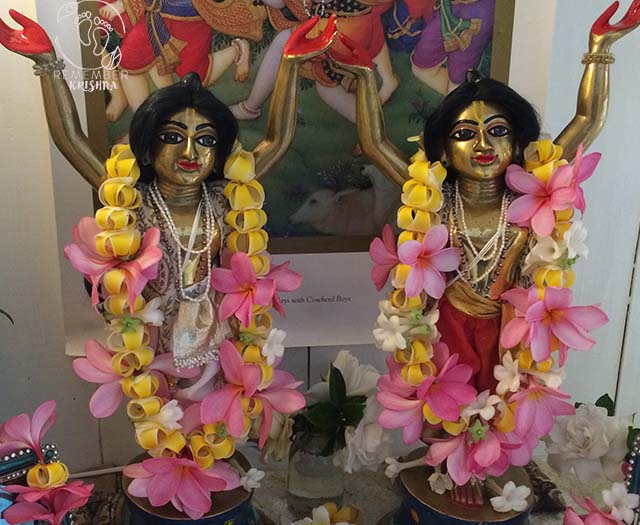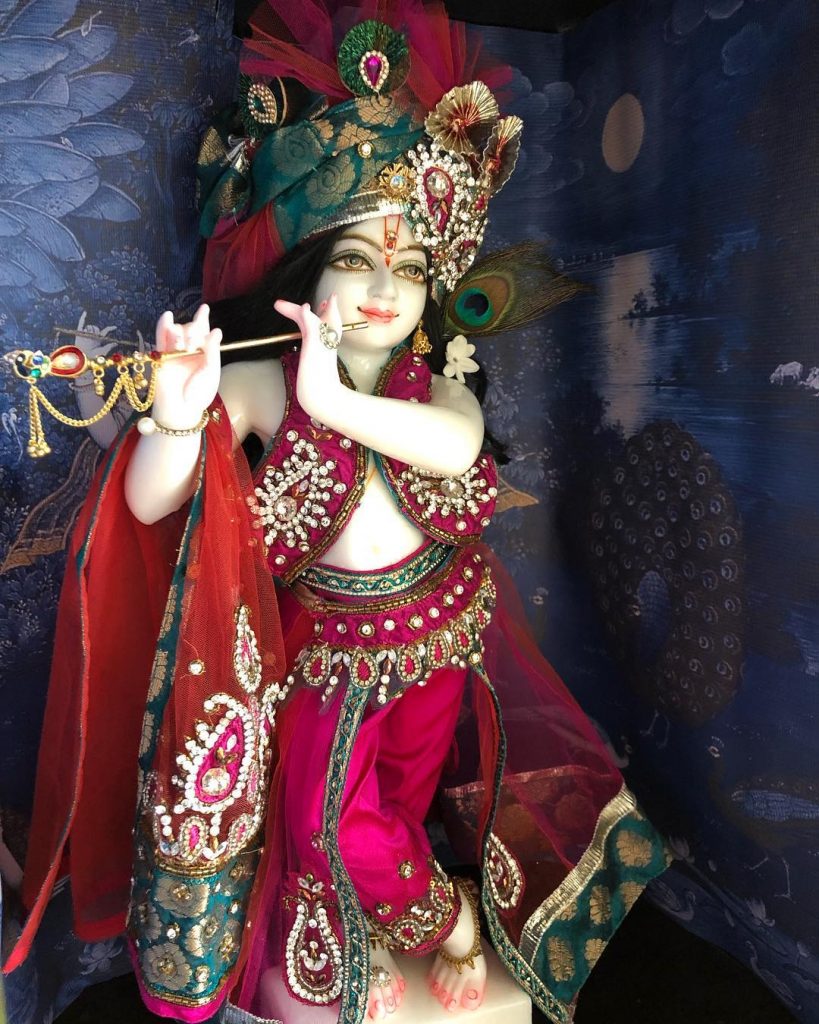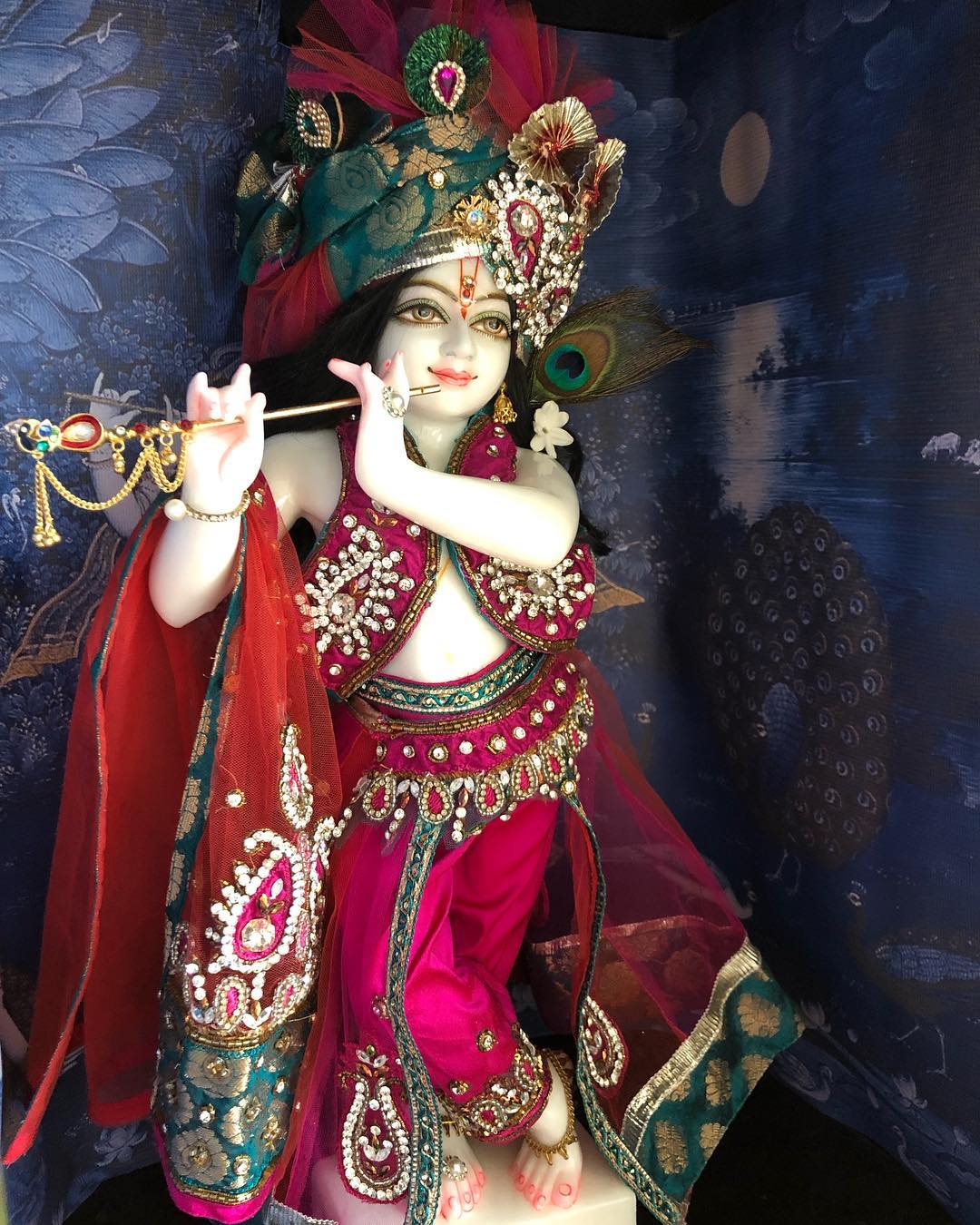
Oh how incredible!
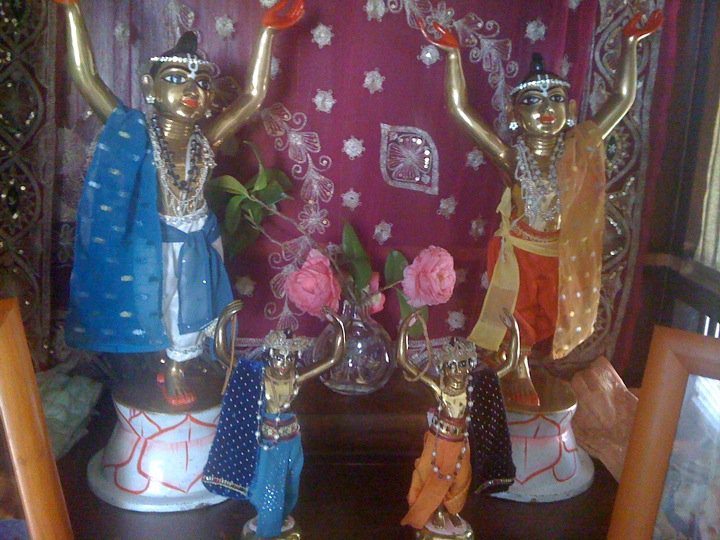
You have a 3D form of the Lord to worship – Hurrah! Hari! Jai! Haribol!
Now you might be wondering about how to install their Lordships!
You can do yourself a great and exciting favour by looking to the installation ceremony instigated by Madhavendra Puri under the direction of Sri Gopala as described in the pastime : Ksiracora “the milk thief”.
Gopal instructs Madhavendra Puri:
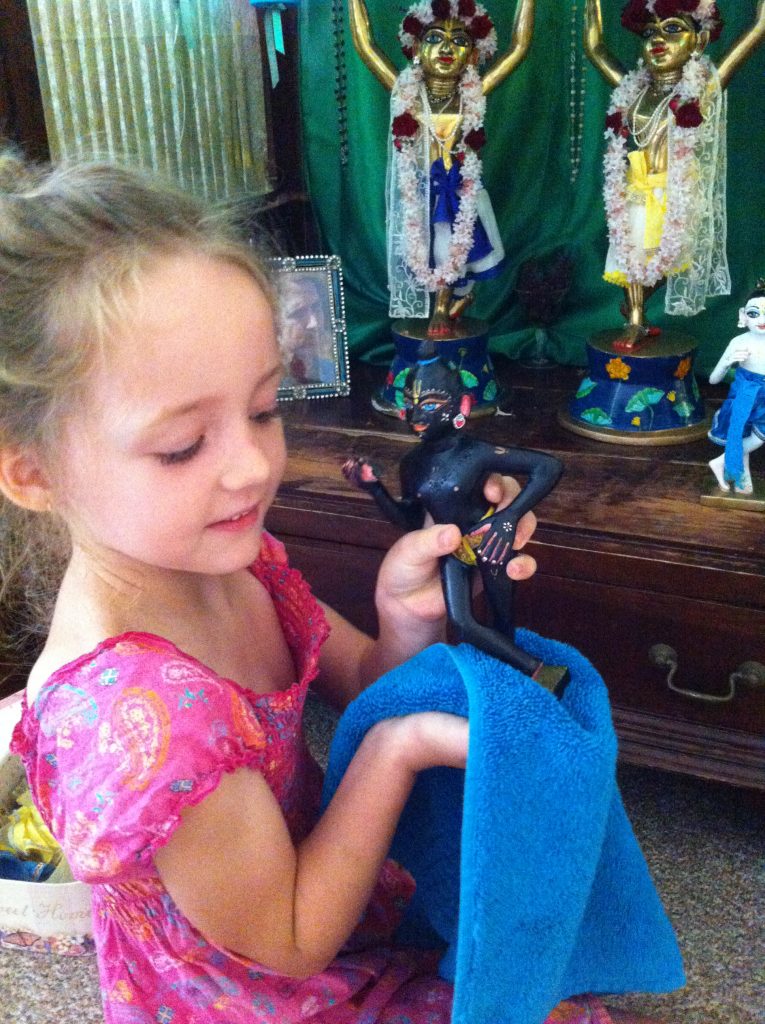
“Clean my body then wash it with fresh water and offer nice eatables.”
In our sampradiya we are most mercifully blessed by Lord Gauranga and Sri Nityananda with the sublime sankirtan, chanting of Sri Krishna holy names. We should Chant and chant and chant to worship the lord.
Lord Caitanya’s followers disciplic succession have presented many authorized books discussing His philosophy and pastimes. The incident of Lord Krsna’s appearing before the devotee Madhavendra Puri in the form of a most worshipable stone Deity (arca-murti) was first told to Lord Caitanya by His spiritual master, and as described here Lord Caitanya later related it to His followers The practice of worshiping the Supreme deity form made of stone, wood or metal strictly follows the Vedic Scriptural injunctions; one should not, therefore, consider this to be idol worship.
Since we cannot see Krsna in the material world in His original form, by His mercy He becomes visible to us in the form of a Deity, such as the Deities Gopala, Gopinathaji and Jagannatha. One should not think Krsna to be stone or wood; Krsna is always Krsna, the eternal form of bliss and knowledge, but He appears as stone or metal because we cannot see His original spiritual form. By serving the Deity, one associates with Krsna personally. A devotee should not think “Here is stone Krsna,” for although because Krsna is everything He is also stone, Krsna in the Deity form is not the kind of stone that cannot act; rather He can act as the Supreme Lord, even in His stone form. In the temples of the Krsna consciousness movement, under the direction of His Divine Grace A.C. Bhaktivedanta Swami Prabhupada, the worship of the Deities by dressing, feeding and caring for Them is an important part of devotional service. Our spiritual master has said in this regard, “As you give more service to Krsna, He will even speak to you.” This actually happened to Madhavendra Puri, as described in the following narration.
The story begins in the house of Lord Caitanya’s close associate Advaita Acarya, where Lord Caitanya briefly stopped on His journey to Puri, the holy city of Lord Jagannatha. This is an excerpt from an unpublished book by His Divine Grace entitled Lord Caitanya—His Sannyasa and Sankirtan Movement.)
As long as Lord Caitanya lived in the house of Srila Advaita Prabhu, the duty of cooking was entrusted to Sacimata, Lord Caitanya’s mother, for at this last opportunity she herself wanted to feed Lord Caitanya and His devotees to her heart’s content. Every day the Lord wanted to take leave of His friends and start out for Puri, but every day the devotees requested Him to remain for two or three days more, and the kind Lord could not refuse the request. Thus the functions of honoring mahaprasada, holding discourses on spiritual subjects and performing congregational chanting of the holy name Hari, accompanied by music and dance, smoothly continued at Advaita’s home. Lord Caitanya pleased His mother by accepting, with His numerous devotees, the foodstuffs that she cooked.
One day the Lord requested all His devotees who had assembled there to disperse to their respective homes. He advised them to continue the performance of sankirtana in each and every house. They would again see the Lord in time when they visited Niladri (Puri). Sometimes the Lord might also return to Navadvipa to bathe in the Ganges. Advaitacarya, however, requested the Lord to take with Him four of His associates, namely, Nityananda Gosvami, Pandita Jagadananda, Damodara Pandita and Mukundadatta. The Lord then took leave of His mother by touching her feet and circumambulating her holy person.
The Lord started for Puri, and cries of lamentation were heard from the house of Advaita Prabhu. Crying at separation from Him, the Acarya began to follow the Lord, but the Lord requested him to go back and console His mother and the other devotees. Saying this, the Lord embraced him and went on calmly.
Accompanied by His four abovementioned associates, the Lord proceeded towards Puri via Chatrabhoja. This route stretches from Santipura along the bank of the Ganges to Atisan, Panhatie (Sodepura-agarpara) and Barahanagar (a suburb of Calcutta). In those days the waters of the Ganges flowed by the town of Kali-ghata. The Ganges now flowing by Bhuwanipore and Kali-ghat is therefore known as Adiganga (the original Ganges). This course of the Ganges flowed down via Diamond Harbor by the police station known as Mathurapura. Passing via this Chatrabhoja, the Lord gradually reached the border of Orissa through Briddha-mantreswar.
On His onward march toward Puri through the villages of Bengal and Orissa, the Lord Himself sometimes used to beg alms from the villagers. Customs officers on His way did not disturb Him, and thus He at last reached Remuna, a village about eight miles west of Balasore. Here the temple and Deity of Ksiracora Gopinatha are situated. The Deity Gopinatha is notorious as a thief because He once stole condensed milk for the sake of His beloved devotee. In the transcendental relationship between the Absolute Godhead and His devotees, both the devotees and God Himself take the risk of serving each other at all costs. In transcendence, therefore, notoriousness has the same absolute connotation as eminence.
The story behind Gopinatha’s being notorious as Ksiracora (“the milk thief”) was long before narrated to Lord Caitanya by His spiritual master, Isvara Puri, and the Lord wanted to repeat the story to His followers.
Although Lord Caitanya was the Supreme Godhead, He accepted Isvara Puri as His spiritual master, and by this act He taught us to accept a guru, or spiritual master, in the line of spiritual disciplic succession. Lord Caitanya introduced Himself as belonging to the Brahma-Madhva-sampradaya, or the chain of disciplic succession that descends from Sri Krsna in the following manner. Sri Krsna, the Supreme Personality of Godhead, transmitted transcendental knowledge to Brahma, from Brahma it came down to Narada, and from Narada to Vyasadeva, who is said to have initiated Madhvacarya. From Madhvacarya the disciplic succession descended as follows: (1) Nrhari, (2) Madhava, (3) Aksobhya, (4) Jayatirtha, (5) Jnanasindhu, (6) Dayanidhi, (7) Vidyanidhi, (8) Rajendra, (9) Jayadharma, (10) Purusottama, (11) Brahmanyatirtha, (12) Vyasatirtha, (13) Laksmipati, (14) Madhavendra Puri, (15) Isvara Puri and (16) Lord Caitanya.
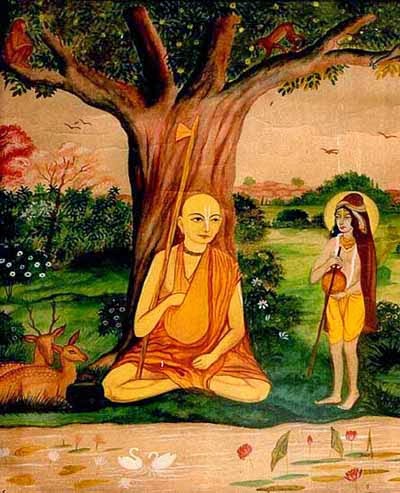
Introducing the story of Gopinatha’s stealing some condensed milk for Madhavendra Puri, Lord Caitanya related that Madhavendra Puri always remained in trance and chose to wander alone, unaccompanied by his disciples. When Madhavendra Puri was in Vrndavana, he was once sitting under a tree near Govardhana Hill. He did not have any food, but a young cowherd boy appeared before him with a pot of milk and offered it to him. The cowherd boy inquired why he did not ask for alms, and he also asked what he did in his meditation.
The svami, Madhavendra Puri, was very pleased to see the beauty of the cowherd boy, and he forgot all about his hunger and thirst. He asked the boy where he lived and how he knew that he was hungry. The boy replied that he was a resident of Govardhana Hill and that no one in his jurisdiction remained hungry. Some of the village women had seen the svami sitting underneath a tree without food and had conveyed the news to him. Saying this, the boy left without further delay on the plea that he had to milk his cows.
Puri Svami drank the milk left by the cowherd boy and waited in vain for him to return to take back his pot. He sat down under the same tree the whole night, chanting the holy name of Hari (Krsna), and at the end of the night, when he lightly slept, he dreamt that the same boy had come again and taken him by his hand to a place congested with creepers and plants.
The boy explained that he had lived in that hedge for a very long time and was suffering through the winter, summer and rainy seasons without an adequate shelter. He was just waiting for Madhavendra Puri’s arrival, for he intended to expose himself to the eyes of people in general by accepting his loving service.
The arca form of the Absolute Personality of Godhead is identical with Him. The Absolute Godhead is not different from His name, fame, form, pastimes, qualities and entourage. He descends to favor His bona fide devotees and appreciate their transcendental loving service. The name, form, and so on, of the Absolute Godhead, being absolute themselves, cannot be experienced by the material instruments of sense perception, but by the unbounded mercy of the Absolute the transcendental loving service of His devotees makes it possible for one to see Him as He is.
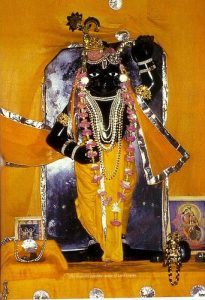 The transcendental cowherd boy agreed to come within the view of the general public in His arca-murti because He was pleased with the loving devotion of Madhavendra Puri. The arca-murti of Godhead is not, therefore, an idol fashioned by an iconographer. The arca-murti is potent and has all the transcendental qualities of the Absolute Godhead, but one can perceive them only through loving service. A material example may help one understand this. The post office authorities establish a mailbox near one’s home, and all letters posted in it reach their respective destinations without difficulty. An imitation mailbox designed to compete with the genuine one will not serve the same purpose; the letters posted in the imitation box will never reach their destinations. The difference between the two boxes is that one is authorized whereas the other is a mere facsimile.
Just as a genuine mailbox is different from an imitation one, so the arca-murti revealed to the general public by a devotee of the caliber of Madhavendra Puri is different from the idols of iconographers. The icons of the idolators are like the statues installed in parks and Squares for the appreciation of the public. These statues serve no other purpose than to provide sitting places for crows; they cannot do anything, no matter how extensive one’s prayers or admiration.
Therefore, the arca-murti of Gopala who out of His own mercy directed Madhavendra Puri to bring Him out into the open must not be mistaken to be an idol, but He must be accepted as the Absolute Godhead Himself.
The next morning, therefore, Puri Svami approached the villagers of Govardhana and asked them to help him extricate the arca-murti of Gopala who was in the dense forest. The villagers gladly followed him and cleared the way for him to enter the place he pointed out. When the tangle of plants and creepers was removed, the weighty figure of Godhead was found. Some of the strongest among the men put their shoulders together and carried the Deity to the top of the hill of Govardhana, where the Deity was set on a big throne of stone and supported by another big stone from behind.
All the villagers were somehow informed of the Deity’s presence, and they came there in large numbers, the brahmanas bringing with them new earthen pots full of strained water from Govinda-kunda (a sacred pond). The water pots were one hundred in number. A festival then ensued, as bands performed and the village women sang songs. Some of the village folk began dancing, and the villagers duly brought forward milk, curd and clarified butter that they had collected for the Deity. Sweetmeats and other foodstuffs of various descriptions, along with numerous presents such as flowers, tulasi plants, new clothing and so on, came in abundance.
Madhavendra Puri personally performed the preliminary function of abhi-seka (a ceremony to sanctify the Deity) by washing His entire body with the water brought in the earthen pots and smearing His body with fragrant oil. After the ablution of the Deity, he properly dressed the Lord’s body and decorated Him with flowers mixed with the paste of sandalwood. Aratrika was then offered to the Deity to welcome and worship Him, and all the foodstuffs brought by the villagers, as well as more food especially prepared for Him, were presented before Gopala.
Ten brahmana cooks were engaged to cook rice and dahl, five brahmanasto prepare vegetables and five to seven brahmanas to bake bread. All the cooked foods were finished by the addition of abundant clarified butter. Then the rice was stacked on the floor upon a new cloth spread out for this purpose, and the bread was exhibited before the Deity in the manner of small hills. The vegetable curries, cakes and other preparations were all brought forward in suitable pots, and fragrant, cold drinking water was also offered in many new earthen pots. In this way the Annakuta ceremony* was again revived by Puri Maharaja, and Gopala, the Absolute Personality of Godhead, who had been hungry for a long time before Madhavendra Puri’s arrival, ate all these transcendental cooked foodstuffs to His heart’s content. Although Gopala ate all the food, leaving not a bit of it, He again restored it all by a transcendental touch of His hand. Only Puri Maharaja perceived this spiritual process, for Gopala was unable to conceal His inconceivable acts from an associate like Madhavendra Puri.
We have already discussed some logical conclusions about the arca-murtiat some length, and now we may also discuss to some extent the offering of foodstuffs to the Deity. The arca-murti accepts only foodstuffs offered by bona fide devotees. The Absolute Godhead is always perfectly full in all respects, but He condescends to accept an offering of flowers, leaves, fruit or water if it is offered in transcendental loving service. If one is not hungry he is reluctant to accept even the most delicious and palatable dishes because in the absence of hunger nothing is pleasing to the taste. But if one is actually hungry he may accept food which is not even palatable. God, however, being full in Himself, is both hungry and satisfied simultaneously. Although He is always satisfied, He becomes hungry when one offers food to Him with a fully devotional attitude of transcendental loving service. He then accepts the food for the sake of His servitor and again replaces it with His transcendental potency to influence the revival of the spiritual senses of everyone who partakes of the remnants of such prasada (spiritualized food). Therefore, there is a gulf of difference between distribution of ordinary foodstuffs and distribution of spiritualized prasada. By accepting and distributing the former, both the giver and the taker become subject to the laws of karma, whereas by accepting and distributing the latter, both the giver and taker transcend the laws of karma. To offer cooked or uncooked foodstuffs to the Deity is to perform yajna(sacrifice) as ordained in the sastras (scriptures), but to cook or collect foodstuffs for one’s own self is to put oneself under the severe laws of nature. By performing yajnas we can have foodstuffs in abundance from the storehouse of nature, but campaigns encouraging farmers to grow more food for our own use simply enrage nature, who then restricts the supply. Such campaigns for self-satisfaction are sure to aggravate scarcity in the world, in spite of all scientific assurances to the contrary. Since the leaders of materialistic nations do not know this secret law of nature, when their materialistic endeavors are baffled at the cost of the lives of many innocent followers, these leaders, not knowing the defects in their foolish acts, escape by saying that nature is unkind.
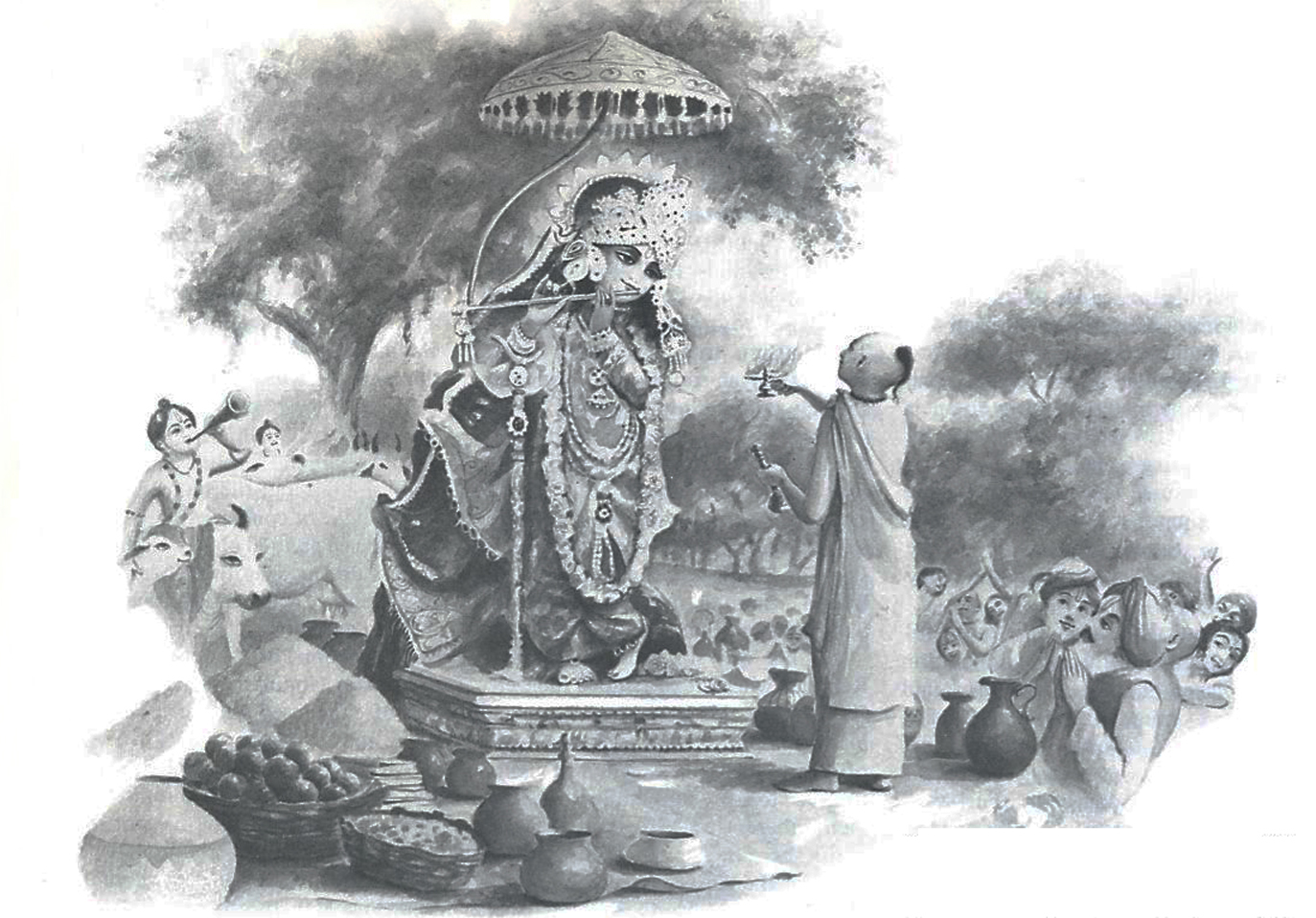
Led by Madhavendra Puri, the villager welcomed and worshiped the Deity. Pleased by devotion, the transcendental cowherd boy agreed to become visible to the public.
Following the Vedic process, therefore, the foodstuffs were all offered to the Deity, and by the order of Puri Maharaja the prasada was lavishly distributed to all the villagers, including old men, women and children. First it was offered to the brahmanas and their wives, and then to all others, one after another. The men who came from other villages to see the function were also sumptuously fed, and everyone was astonished to see the influence of Puri Gosvami. Puri Maharaja then turned all the brahmanas into Vaisnavas (devotees) and entrusted them with various duties in the service of the Lord, for it is the function of a bona fide spiritual master not only to engage himself in the Lord’s service but also to engage all others who accept him as their spiritual master.
The entire country was informed of the appearance of Gopala, and thus men from all the neighboring villages came to visit Him. All the different groups of villagers asked to perform the Annakuta ceremony in turn, and thus day after day the villagers brought rice, dahl, wheat products, vegetables, clarified butter, milk, sweetmeats, flowers and various other offerings for the Deity. The brahmanas again and again cooked and offered foodstuffs to Gopala and distributed prasada to all.
Gopala Himself, being the Personality of Godhead, is the natural center of gravity for all people—namely, brahmanas (intellectuals), ksatriyas(administrators), vaisyas (agriculturalists) and sudras (laborers). According to Srimad-Bhagavatam, the brahmanas constitute the face of the Deity, the ksatriyas His arms, the vaisyas His thighs and the sudras His legs. None is less dignified in terms of the transcendental service he offers as a limb of the transcendental body of Gopala. When, however, the brahmanas, ksatriyasand other occupational communities forget their relationship with the loving service of Gopala, they become degraded. By forgetting the service of Gopala one forgets his constitutional position and is thus deluded by maya (the illusory energy). Covered by such maya, one tries to enjoy material nature on one’s own account, which one cannot do, instead of serving Gopala by the grace of spiritual nature. This causes a struggle for false supremacy among the various classes or castes, bringing about the destruction of everything that they try to enjoy.
The true realization of a peaceful society is possible through cooperation of all classes or castes, centered around the transcendental service of Gopala. The villagers of Govardhana and other neighboring towns, acting under the guidance of Madhavendra Puri with Gopala as the Lord of all, offer an ideal example of how to live in a spiritual society that can bring about real peace and prosperity. In such a society there is direct communion with God, for its members realize that everything is for God and that God is for everyone, irrespective of caste, creed or color. In such a perfect society, Gopala is the center of all.
The holy place of Gopala thus became well known to everyone, and whoever came there offered as much as he could afford. Rich men offered costly clothing and many valuable gold and silver ornaments, and one rich ksatriya who came there built a big temple for Gopala. Some of the villagers constructed boundary walls, and others erected a cooking house. Each one of the inhabitants of Vraja gave one cow to Gopala, and in that way about 10,000 cows were collected for His service. The four occupational orders of society thus contributed their skills for the service of Gopala. Two renounced brahmanas who came from Bengal were carefully provided for at the temple. These two brahmanas, who became disciples of Madhavendra Puri, were entrusted with the daily worship of the Deity.