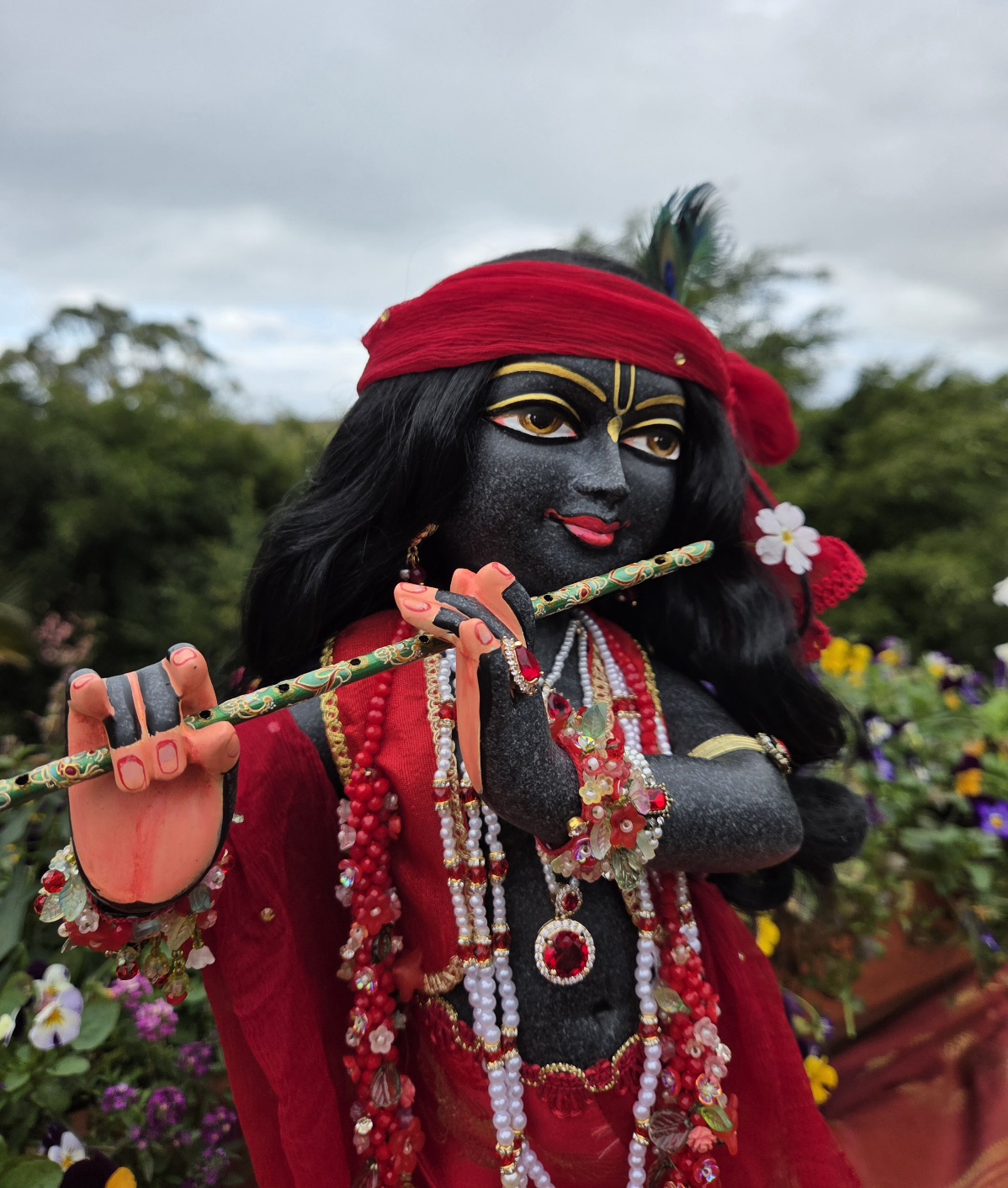
Few stories capture the tender intimacy between the Lord and His devotee quite like the tale of a Lord who turns thief for a single pot of sweet rice.
The story of Sri Madhavendra Puri and Ksira-cora Gopinatha is narrated in Chapter 4 of the Caitanya-caritamrta (Madhya-lila), where Sri Caitanya Mahaprabhu recounts the pastime to His companions while visiting the temple in Remuna, Odisha.
Going into South India, Śrī Mādhavendra Purī visited Remuṇā, where Gopīnātha is situated. Upon seeing the beauty of the Deity, Mādhavendra Purī was overwhelmed.
In the corridor of the temple, from which people generally viewed the Deity, Mādhavendra Purī chanted and danced. Then he sat down there and asked a brāhmaṇa what kinds of foods they offered to the Deity.
From the excellence of the arrangements, Mādhavendra Purī understood by deduction that only the best food was offered.
Mādhavendra Purī thought, “I shall inquire from the priest what foods are offered to Gopīnātha so that by making arrangements in our kitchen, we can offer similar foods to Śrī Gopāla.”
When the brāhmaṇa priest was questioned about this matter, he explained in detail what kinds of foods were offered to the Deity of Gopīnātha.
The brāhmaṇa priest said, “In the evening the Deity is offered sweet rice in twelve earthen pots. Because the taste is as good as nectar [amṛta], it is named amṛta-keli.
“This sweet rice is celebrated throughout the world as gopīnātha-kṣīra. It is not offered anywhere else in the world.”
While Mādhavendra Purī was talking with the brāhmaṇa priest, the sweet rice was placed before the Deity as an offering. Hearing this, Mādhavendra Purī thought as follows.
“If, without my asking, a little sweet rice is given to me, I can then taste it and make a similar preparation to offer my Lord Gopāla.”
Mādhavendra Purī became greatly ashamed when he desired to taste the sweet rice, and he immediately began to think of Lord Viṣṇu. While he was thus thinking of Lord Viṣṇu, the offering was completed, and the ārati ceremony began.
After the ārati was finished, Mādhavendra Purī offered his obeisances to the Deity and then left the temple. He did not say anything more to anyone.
Mādhavendra Purī avoided begging. He was completely unattached and indifferent to material things. If, without his begging, someone offered him some food, he would eat; otherwise he would fast.
Purport
This is the paramahaṁsa stage, the highest stage for a sannyāsī. A sannyāsī can beg from door to door just to collect food, but a paramahaṁsa who has taken ayācita-vṛtti, or ājagara-vṛtti, does not ask anyone for food. If someone offers him food voluntarily, he eats. Ayācita-vṛtti means being accustomed to refrain from begging, and ājagara-vṛtti indicates one who is compared to a python, the big snake that makes no effort to acquire food but rather allows food to come automatically within its mouth. In other words, a paramahaṁsa simply engages exclusively in the service of the Lord without caring even for eating or sleeping. It was stated about the six Gosvāmīs: nidrāhāra-vihārakādi-vijitau. In the paramahaṁsa stage one conquers the desire for sleep, food and sense gratification. One remains a humble, meek mendicant engaged in the service of the Lord day and night. Mādhavendra Purī had attained this paramahaṁsa stage.
A paramahaṁsa like Mādhavendra Purī is always satisfied in the loving service of the Lord. Material hunger and thirst cannot impede his activities. When he desired to taste a little sweet rice offered to the Deity, he considered that he had committed an offense by desiring to eat what was being offered to the Deity.
Purport
It is advisable that food being offered to the Deity be covered when taken from the kitchen to the Deity room. In that way, others may not see it. Those who are not accustomed to following the advanced regulative devotional principles may desire to eat the food, and that is an offense. Therefore no one should be given a chance to even see it. However, when it is brought before the Deity, it must be uncovered. Seeing the food uncovered before the Deity, Mādhavendra Purī desired to taste a little of it so that he could prepare a similar sweet rice for his Gopāla. Mādhavendra Purī was so strict, however, that he considered this to be an offense. Consequently he left the temple without saying anything to anyone. The paramahaṁsa is therefore called vijita-ṣaḍ-guṇa. He must conquer the six material qualities — kāma, krodha, lobha, moha, matsarya and kṣudhā-tṛṣṇā (lust, anger, greed, illusion, enviousness and hunger and thirst).
Mādhavendra Purī left the temple and sat down in the village marketplace, which was vacant. Sitting there, he began to chant. In the meantime, the temple priest laid the Deity down to rest.
Purport
Although Mādhavendra Purī was not interested in eating and sleeping, his interest in chanting the mahā-mantra was as acute as if he were an aspiring transcendentalist rather than a paramahaṁsa. This means that even in the paramahaṁsa stage, one cannot give up chanting. Haridāsa Ṭhākura and the Gosvāmīs were all engaged in chanting a fixed number of rounds; therefore chanting on beads is very important for everyone, even though one may become a paramahaṁsa. This chanting can be executed anywhere, either inside or outside the temple. Mādhavendra Purī even sat down in a vacant marketplace to perform his chanting. As stated by Śrīnivāsa Ācārya in his prayers to the Gosvāmīs: nāma-gāna-natibhiḥ. A paramahaṁsa devotee is always engaged in chanting and rendering loving service to the Lord. Chanting the Lord’s holy names and engaging in His service are identical. As stated in Śrīmad-Bhāgavatam (7.5.23), there are nine kinds of devotional service: hearing (śravaṇam), chanting (kīrtanam), remembering (viṣṇoḥ smaraṇam), serving (pāda-sevanam), worship of the Deity (arcanam), praying (vandanam), carrying out orders (dāsyam), serving Him as a friend (sakhyam) and sacrificing everything for the Lord (ātma-nivedanam). Although each process appears distinct, when one is situated on the absolute platform he can see that they are identical. For instance, hearing is as good as chanting, and remembering is as good as chanting or hearing. Similarly, engaging in Deity worship is as good as chanting, hearing or remembering. The devotee is expected to accept all nine processes of devotional service, but even if only one process is properly executed, he can still attain the highest position (paramahaṁsa) and go back home, back to Godhead.
Finishing his daily duties, the priest went to take rest. In a dream he saw the Gopīnātha Deity come to talk to him, and He spoke as follows.
“O priest, please get up and open the door of the temple. I have kept one pot of sweet rice for the sannyāsī Mādhavendra Purī . This pot of sweet rice is just behind My cloth curtain. You did not see it because of My tricks.
“A sannyāsī named Mādhavendra Purī is sitting in the vacant marketplace. Please take this pot of sweet rice from behind Me and deliver it to him.”
Awaking from the dream, the priest immediately rose from bed and thought it wise to take a bath before entering the Deity’s room. He then opened the temple door.
According to the Deity’s directions, the priest found the pot of sweet rice behind the cloth curtain. He removed the pot and mopped up the place where it had been kept. He then went out of the temple.
Closing the door of the temple, he went to the village with the pot of sweet rice. He called out in every stall in search of Mādhavendra Purī.
Holding the pot of sweet rice, the priest called, “Will he whose name is Mādhavendra Purī please come and take this pot! Gopīnātha has stolen this pot of sweet rice for you!”
Purport
The difference between the Absolute Truth and relative truth is explained here. Lord Gopīnātha has openly declared herein that He is a thief. He had stolen the pot of sweet rice, and this was not kept a secret because His act of stealing is a source of great transcendental bliss. In the material world, theft is criminal, but in the spiritual world the Lord’s stealing is a source of transcendental bliss. Mundane rascals, who cannot understand the absolute nature of the Personality of Godhead, sometimes call Lord Śrī Kṛṣṇa immoral, but they do not know that His seemingly immoral activities, which are not kept secret, afford pleasure to the devotees. Not understanding the transcendental behavior of the Supreme Personality of Godhead, these rascals slur His character and immediately fall into the category of miscreants (rascals, lowest among men, demons and those whose knowledge is taken away by the illusory energy). Kṛṣṇa explains in the Bhagavad-gītā (7.15):na māṁ duṣkṛtino mūḍhāḥ prapadyante narādhamāḥ
māyayāpahṛta-jñānā āsuraṁ bhāvam āśritāḥ
“Those miscreants who are grossly foolish, who are lowest among mankind, whose knowledge is stolen by illusion, and who partake of the atheistic nature of demons do not surrender unto Me.” (Bg. 7.15)
Mundane rascals cannot understand that whatever Kṛṣṇa does, being absolute in nature, is all-good. This quality of the Lord is explained in Śrīmad-Bhāgavatam (10.33.29). One may consider certain acts of a supremely powerful person to be immoral by mundane calculations, but this is not actually the case. For example, the sun absorbs water from the surface of the earth, but it does not absorb water only from the sea. It also absorbs water from filthy sewers and ditches containing urine and other impure substances. The sun is not polluted by absorbing such water. Rather, the sun makes the filthy place pure. If a devotee approaches the Supreme Personality of Godhead for an immoral or improper purpose, he nonetheless becomes purified; the Lord does not become infected. In Śrīmad-Bhāgavatam (10.29.15) it is stated that if one approaches the Supreme Lord even out of lust, anger or fear (kāmaṁ krodhaṁ bhayam), he is purified. The gopīs, being young girls, approached Kṛṣṇa because He was a beautiful young boy. From the external point of view, they approached the Lord out of lust, and the Lord danced with them at midnight. From the mundane point of view, these activities may appear immoral because a married or unmarried young girl cannot leave home to mix with a young boy and dance with him. Although this is immoral from the mundane viewpoint, the activities of the gopīs are accepted as the highest form of worship because it was Lord Kṛṣṇa whom they approached with lusty desires in the dead of night.
But these things cannot be understood by nondevotees. One must understand Kṛṣṇa in tattva (truth). One should use his common sense and consider that if simply by chanting Kṛṣṇa’s holy name one is purified, how then can the person Kṛṣṇa be immoral? Unfortunately, mundane fools are accepted as educational leaders and are offered exalted posts for teaching irreligious principles to the general populace. This is explained in Śrīmad-Bhāgavatam (7.5.31): andhā yathāndhair upanīyamānāḥ. Blind men are trying to lead other blind men. Due to the immature understanding of such rascals, common men should not discuss Kṛṣṇa’s pastimes with the gopīs. A nondevotee should not even discuss His stealing sweet rice for His devotees. It is warned that one should not even think about these things. Although Kṛṣṇa is the purest of the pure, mundane people, thinking of Kṛṣṇa’s pastimes that appear immoral, themselves become polluted. Śrī Caitanya Mahāprabhu therefore never publicly discussed Kṛṣṇa’s dealings with the gopīs. He used to discuss these dealings only with three confidential friends. He never discussed rāsa-līlā publicly, as the professional reciters do, although they do not understand Kṛṣṇa or the nature of the audience. However, Śrī Caitanya Mahāprabhu encouraged the public chanting of the holy name on a huge scale for as many hours as possible.
The priest continued, “Would the sannyāsī whose name is Mādhavendra Purī please come and take this pot of sweet rice and enjoy the prasādam with great happiness! You are the most fortunate person within these three worlds!”
Purport
Here is an example of a personal benediction by Kṛṣṇa’s immoral activity. By Gopīnātha’s stealing for His devotee, the devotee becomes the most fortunate person within the three words. Thus even the Lord’s criminal activities make His devotee the most fortunate person. How can a mundane rascal understand the pastimes of Kṛṣṇa and judge whether He is moral or immoral? Since Kṛṣṇa is the Absolute Truth, there are no mundane distinctions such as moral and immoral. Whatever He does is good. This is the real meaning of “God is good.” He is good in all circumstances because He is transcendental, outside the jurisdiction of this material world. Therefore, Kṛṣṇa can be understood only by those who are already living in the spiritual world. This is corroborated in the Bhagavad-gītā (14.26):māṁ ca yo ’vyabhicāreṇa bhakti-yogena sevate
sa guṇān samatītyaitān brahma-bhūyāya kalpate
“One who engages in full devotional service, unfailing in all circumstances, at once transcends the modes of material nature and thus comes to the level of Brahman.”
One who is engaged in unalloyed devotional service to the Lord is already situated in the spiritual world (brahma-bhūyāya kalpate). In all circumstances, his activities and dealings with Kṛṣṇa are transcendental and thus not understandable by mundane moralists. It is therefore better not to discuss such activities among mundane people. It is better to give them the Hare Kṛṣṇa mahā-mantra so that they will be gradually purified and then come to understand the transcendental activities of Kṛṣṇa.
Hearing this invitation, Mādhavendra Purī came out and identified himself. The priest then delivered the pot of sweet rice and offered his obeisances, falling flat before him.
Purport
A brāhmaṇa is not supposed to offer his obeisances by falling flat before anyone because a brāhmaṇa is considered to be in the highest caste. However, when a brāhmaṇa sees a devotee, he offers his daṇḍavats. This brāhmaṇa priest did not ask Mādhavendra Purī whether he was a brāhmaṇa, but when he saw that Mādhavendra Purī was such a bona fide devotee that Kṛṣṇa would even steal for him, he immediately understood the position of the saint. As stated by Śrī Caitanya Mahāprabhu: kibā vipra, kibā nyāsī, śūdra kene naya/ yei kṛṣṇa-tattva-vettā, sei ‘guru’ haya. (Cc. Madhya 8.128) Had the brāhmaṇa priest been an ordinary brāhmaṇa, Gopīnātha would not have talked with him in a dream. Since the Deity spoke to both Mādhavendra Purī and the brāhmaṇa priest in dreams, practically speaking they were on the same platform. However, because Mādhavendra Purī was a senior sannyāsī Vaiṣṇava, a paramahaṁsa, the priest immediately fell flat before him and offered obeisances.
When the story about the pot of sweet rice was explained to him in detail, Śrī Mādhavendra Purī at once became absorbed in ecstatic love of Kṛṣṇa.
Upon seeing the ecstatic loving symptoms manifest in Mādhavendra Purī, the priest was struck with wonder. He could understand why Kṛṣṇa had become so much obliged to him, and he saw that Kṛṣṇa’s action was befitting.
Purport
A devotee can bring Kṛṣṇa perfectly under his control. This is explained in Śrīmad-Bhāgavatam (10.14.3): ajita jito ’py asi tais tri-lokyām. Kṛṣṇa is never conquered by anyone, but a devotee can conquer Him through devotional service. As stated in the Brahma-saṁhitā (5.33): vedeṣu durlabham adurlabham ātma-bhaktau. One cannot understand Kṛṣṇa simply by reading Vedic literature. Although all Vedic literature is meant for understanding Kṛṣṇa, one cannot understand Kṛṣṇa without being a lover of Kṛṣṇa. Therefore along with the reading of Vedic literature (svādhyāya), one must engage in devotional worship of the Deity (arcana-vidhi). Together these will enhance the devotee’s transcendental understanding of devotional service. Śravaṇādi śuddha-citte karaye udaya (Cc. Madhya 22.107). Love of Godhead is dormant within everyone’s heart, and if one simply follows the standard process of devotional service, it is awakened. But foolish mundane people who simply read about Kṛṣṇa mistakenly think that He is immoral or criminal.
The priest offered his obeisances to Mādhavendra Purī and returned to the temple. Then, in ecstasy, Mādhavendra Purī ate the sweet rice offered to him by Kṛṣṇa.
After this, Mādhavendra Purī washed the pot and broke it into pieces. He then bound all the pieces in his outer cloth and kept them nicely.
Each day, Mādhavendra Purī would eat one piece of that earthen pot, and after eating it he would immediately be overwhelmed with ecstasy. These are wonderful stories.
Having broken the pot and bound the pieces in his cloth, Mādhavendra Purī began to think, “The Lord has given me a pot of sweet rice, and when the people hear of this tomorrow morning, there will be great crowds.”
Thinking this, Śrī Mādhavendra Purī offered his obeisances to Gopīnātha on the spot and left Remuṇā before morning.
Walking and walking, Mādhavendra Purī finally reached Jagannātha Purī, which is also known as Nīlācala. There he saw Lord Jagannātha and was overwhelmed with loving ecstasy.
When Mādhavendra Purī was overwhelmed in the ecstasy of love of Godhead, he sometimes stood up and sometimes fell to the ground. Sometimes he laughed, danced and sang. In this way he enjoyed transcendental bliss by seeing the Jagannātha Deity.
When Mādhavendra Purī came to Jagannātha Purī, people were aware of his transcendental reputation. Therefore crowds of people came and offered him all sorts of respect in devotion.
Even though one may not like it, reputation, as ordained by providence, comes to him. Indeed, one’s transcendental reputation is known throughout the entire world.
Being afraid of his reputation [pratiṣṭhā], Mādhavendra Purī fled from Remuṇā. But the reputation brought by love of Godhead is so sublime that it goes along with the devotee, as if following him.
Purport
Almost all the conditioned souls within the material world are envious. Jealous people generally turn against one who automatically attains some reputation. This is natural for jealous people. Consequently, when a devotee is fit to receive worldly reputation, he is envied by many people. This is quite natural. When a person, out of humility, does not desire fame, people generally think him quite humble and consequently give him all kinds of fame. Actually a Vaiṣṇava does not hanker after fame or a great reputation. Mādhavendra Purī, the king of Vaiṣṇavas, bore his reputation, but he wanted to keep himself outside of the vision of the general populace. He wanted to cover his real identity as a great devotee of the Lord, but when people saw him overwhelmed in the ecstasy of love of Godhead, they naturally gave credit to him. Actually a first-class reputation is due Mādhavendra Purī because he was a most confidential devotee of the Lord. Sometimes a sahajiyā presents himself as being void of desires for reputation (pratiṣṭhā) in order to become famous as a humble man. Such people cannot actually attain the platform of celebrated Vaiṣṇavas.
Śrī Caitanya-caritāmṛta »
Madhya-līlā »
CHAPTER FOUR: Śrī Mādhavendra Purī’s Devotional Service excerpt
This pasttime occurs within the framework of a larger quest, that of Sri Madhavendra Puri seeking out sandalwood pulp for the Gopal deity. That pasttime is glorious and extensive, and will be shared later.